E-BUZZ ME Logo
ScienceTechnical Deep Dive

New JWST Observations Challenge Dark Matter Estimates in the Bullet Cluster

Published
New JWST Observations Challenge Dark Matter Estimates in the Bullet Cluster
1 min read178 words

The Gist

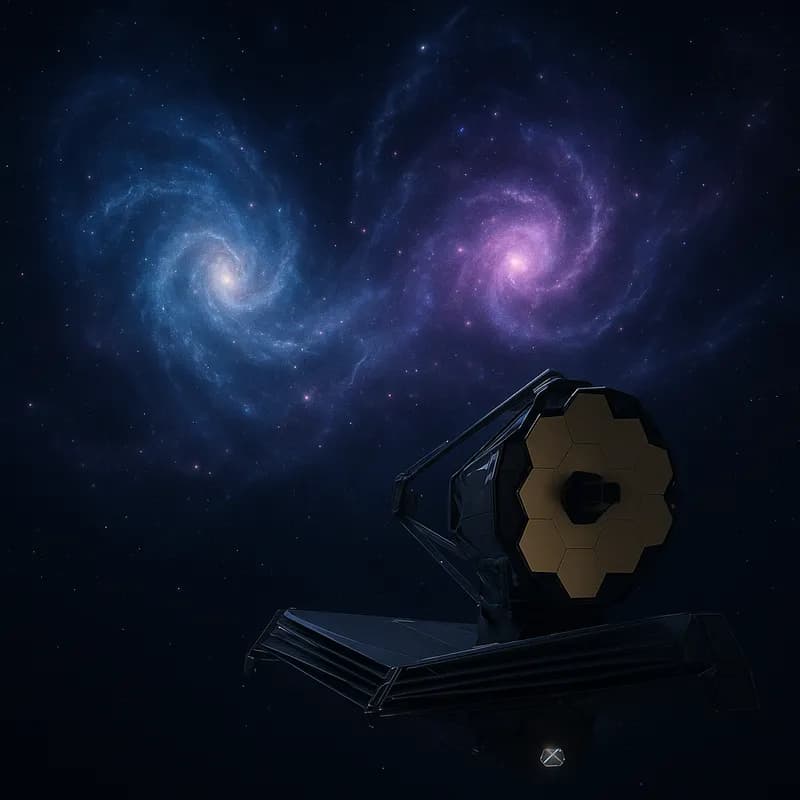
Recent data from the James Webb Space Telescope suggests the Bullet Cluster may contain significantly less dark matter than previously estimated, potentially reshaping our understanding of galactic collisions.

The Bullet Cluster, a famous site of colliding galaxy clusters often cited as definitive proof of dark matter, is under new scrutiny. Data from the James Webb Space Telescope (JWST) indicates that the amount of unseen mass in this cosmic structure might be far lower than earlier models suggested.

A Shift in Calculations

According to researchers analyzing the JWST observations, the required amount of additional dark matter could be as little as half of previous estimates. In some scenarios, the data even hints at the possibility that the cluster contains almost no dark matter at all, though such a conclusion remains highly provocative within the scientific community.

Impact on Modern Physics

For years, the Bullet Cluster served as a cornerstone for the Lambda Cold Dark Matter (ΛCDM) model. By observing the separation between visible gas and the gravitational center of the clusters, scientists believed they were seeing dark matter passing through the collision unaffected. If the JWST data confirms a lower mass requirement, physicists may need to re-evaluate gravitational theories or the specific properties of dark matter particles.


Related Stories

Semantically matched articles, ranked by topic overlap and freshness.

GPS Satellite Network Provides Two Decades of Space Radiation Data
Science69%

GPS Satellite Network Provides Two Decades of Space Radiation Data

A massive cross-calibration effort involving 25 GPS satellites has unlocked twenty years of continuous space radiation tracking.

New Class of Magnons Exhibits Hundred-Fold Increase in Lifespan
Science68%

New Class of Magnons Exhibits Hundred-Fold Increase in Lifespan

A breakthrough discovery of long-lived magnons could pave the way for scalable, nanoscale quantum information technologies on-chip.

The Physics Behind the Snap: Understanding the Venus Flytrap
Science68%

The Physics Behind the Snap: Understanding the Venus Flytrap

New research delves into the complex physics that allows the Venus flytrap to snap shut with incredible speed to capture its prey.

The Future of Open Access: Navigating Structural Challenges and AI Integration
Science67%

The Future of Open Access: Navigating Structural Challenges and AI Integration

As the scientific community pushes for an open-access future, experts warn that systemic issues and the rise of AI must be addressed to ensure sustainability.

John Bell and the Legacy of the Journal 'Physics'
Science67%

John Bell and the Legacy of the Journal 'Physics'

A look back at the short-lived journal where John Bell published his ground-breaking theorem, forever changing our understanding of quantum mechanics.

China’s Tianwen-1 Orbiter Captures Rare Footage of Interstellar Comet 3I/ATLAS
Science63%

China’s Tianwen-1 Orbiter Captures Rare Footage of Interstellar Comet 3I/ATLAS

The Tianwen-1 Mars orbiter has successfully imaged the interstellar visitor 3I/ATLAS, providing a rare look at material originating from outside our solar system.

NASA’s Deep Space Network Threatened by Wildfire
Science62%

NASA’s Deep Space Network Threatened by Wildfire

One of the three critical communication stations enabling NASA to talk to deep space missions is currently facing a direct threat from an active wildfire.

Sweden Explores Rare Earth Deposits to Challenge Global Supply Dominance
Science60%

Sweden Explores Rare Earth Deposits to Challenge Global Supply Dominance

Researchers are mapping Sweden's mineral wealth to create magnets from natural element combinations, aiming to reduce reliance on Chinese exports.