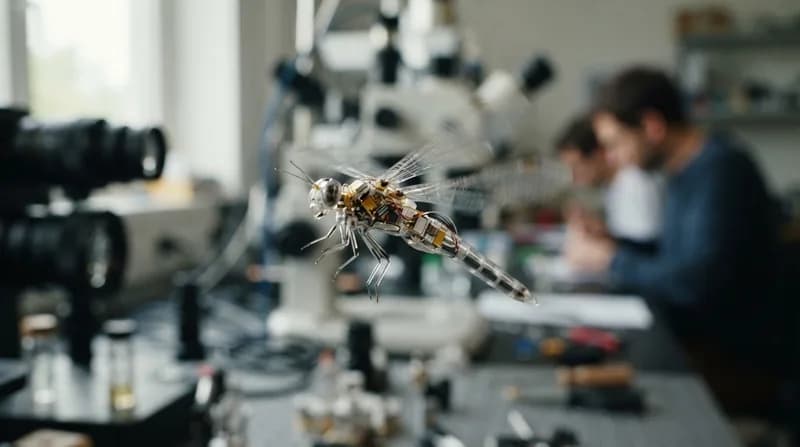
Revolutionizing Miniature Aerial Mobility
For years, the promise of insect-sized robots—tiny machines capable of navigating earthquake rubble or inspecting inaccessible industrial spaces—has been hampered by a lack of maneuverability. While the physical hardware of these microrobots has evolved significantly, their onboard "brains" often struggled to process the complex aerodynamics required for high-speed flight. Now, researchers at MIT have bridged this gap with a sophisticated, dual-layer AI control framework that has boosted robot performance by a massive 450 percent.
The latest iteration of these robots, which are roughly the size of a microcassette and weigh less than a paperclip, utilizes soft artificial muscles to flap their wings at extremely high frequencies. However, it is the new "brain" developed by MIT’s Soft and Micro Robotics Laboratory in collaboration with the Laboratory for Information and Decision Systems that truly changes the game. By moving away from manually tuned controllers to an AI-driven, real-time decision system, the team has enabled the robot to execute maneuvers previously thought impossible at this scale, including ten consecutive somersaults in just 11 seconds.
The Two-Tier AI Architecture
The secret to the robot's newfound agility lies in a tiered control strategy that balances intense computational heavy-lifting with real-time execution. The system functions in two distinct phases:
- Model-Predictive Controller: This serves as the "expert planner." It utilizes a precise mathematical model of the robot's flight dynamics to calculate the most efficient, safe trajectory for complex maneuvers like flips or sharp, high-speed turns. Because it accounts for force and torque limits, it prevents the robot from attempting movements that would result in a crash.
- Imitation Learning Policy: Using the expert planner as a training foundation, the researchers employed deep-learning imitation to create a lighter, faster policy. This AI model acts as the robot’s real-time brain, processing sensor data and outputting thrust and torque commands instantaneously. This allows the robot to react to disturbances—such as sudden wind gusts—without needing the immense processing power required by the expert planner.
Why It Matters
This breakthrough marks a significant paradigm shift in micro-robotics. By demonstrating that insect-scale machines can achieve performance metrics comparable to living insects, the research team is paving the way for a future where autonomous micro-drones can operate in hazardous, debris-filled environments. Beyond search-and-rescue applications, the ability to mimic "saccade" movements—sharp, rapid shifts in pitch used by insects to stabilize vision—will eventually allow these robots to carry onboard cameras and sensors, potentially transforming remote inspections in cramped or dangerous spaces.
Future Outlook
The team is now looking toward full autonomy. With the control system effectively proven, the next phase involves integrating onboard sensors and localized power sources, moving away from the external motion-capture systems currently required for testing. As these robots become smaller and more intelligent, they may eventually operate in swarms, coordinating their movements to navigate complex structures, avoid collisions, and complete collaborative missions in environments where even the smallest conventional drones fail to reach.