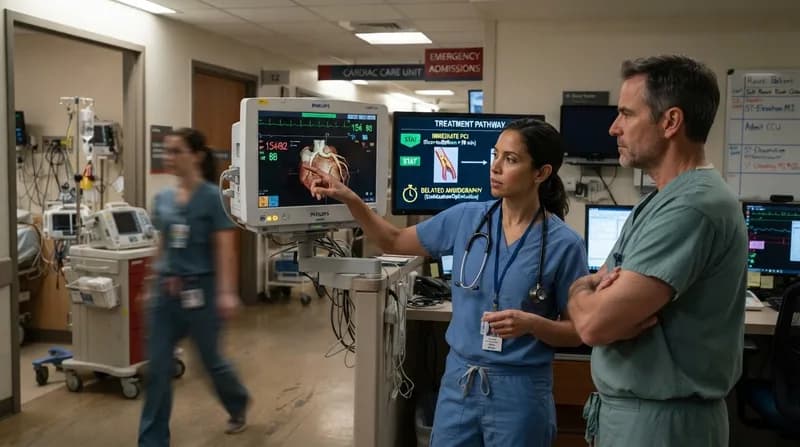
The DISCO trial, published in the New England Journal of Medicine, set out to resolve a persistent question in emergency cardiology: whether performing coronary angiography within 120 minutes of out-of-hospital cardiac arrest improves patient outcomes compared to a deferred approach. The study randomized 1,006 unconscious adult patients across 23 centers in Scandinavia and the Netherlands, making it the largest trial to date addressing this specific clinical dilemma.
Patients were assigned to either an immediate angiography group or a deferred strategy group, where angiography was delayed by at least 72 hours. The results were striking in their consistency: the primary endpoint of 30-day survival showed no significant difference between the two groups, with 54.6% survival in the immediate cohort versus 53.6% in the deferred group (HR 0.95; 95% CI 0.74 to 1.21; p=0.67). This near-identical survival rate held true across 180-day follow-up and in secondary measures of neurological recovery.
To strengthen these findings, an individual patient data meta-analysis of five randomized controlled trials involving a total of 2,173 patients confirmed the lack of benefit, reinforcing that immediate and deferred coronary angiography approaches yield equivalent survival outcomes. Lead investigator Professor Sten Rubertsson emphasized that based on the DISCO trial data, immediate coronary angiography after out-of-hospital cardiac arrest does not improve survival or neurological recovery over a deferred strategy. These results align with and support current clinical guidelines that recommend a deferred strategy for coronary angiography in patients without ST-segment elevation following out-of-hospital cardiac arrest.