The Second Life Revolution
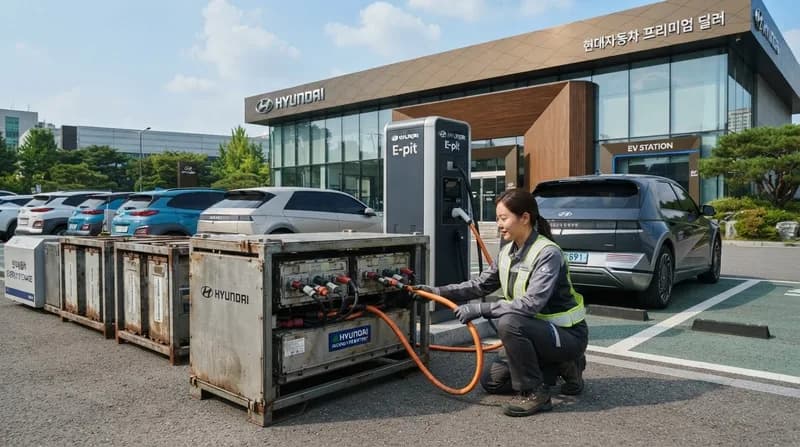
Hyundai Motor Group and LG Energy Solution (LGES) have officially embarked on a pioneering pilot project in South Korea, aiming to prove that an electric vehicle's life doesn't necessarily end when its performance drops below the threshold required for long-range driving. By repurposing battery packs harvested from vehicles built on the company’s dedicated E-GMP platform, the partnership is establishing an innovative stationary energy storage system designed to support high-speed charging infrastructure.
The pilot, located at a Wonik PNE facility in Dongtan, utilizes a 200 kWh storage unit known as the Ultra-Burned Energy Storage System (UBESS). This system acts as a sophisticated buffer between the grid and the charging station. By drawing energy during off-peak hours when grid prices are at their lowest and storing it within these decommissioned packs, the station can deliver high-power charging to vehicles during peak demand periods without straining the local electrical grid.
The Core Objectives
This initiative represents more than just a proof-of-concept; it is a calculated effort to build a viable circular economy for automotive batteries. Beyond the technical feasibility of reusing hardware, the project seeks to establish a replicable business model that ensures safety and efficiency. Hyundai Engineering is playing a key role here, evaluating how these units perform in real-world commercial settings to determine if this can be scaled into a standard component of future EV charging networks.
LG Energy Solution provides the technical backbone for this project, utilizing its advanced battery diagnostics and operational software to verify the state of health and safety of the repurposed cells. Meanwhile, charger manufacturer Wonik PNE manages the technical integration, ensuring the hardware bridges the gap between stored second-life capacity and the rigorous demands of DC fast charging protocols.
Why It Matters
- Grid Stability: Buffering demand prevents expensive spikes in utility costs and reduces the infrastructure load during peak traffic.
- Resource Circularity: Extending the lifecycle of lithium-ion cells reduces the immediate demand for new raw materials and minimizes early-stage waste.
- Scalability: Successfully validating the E-GMP packs proves that mass-produced EV platforms can eventually contribute to their own infrastructure ecosystem long after the cars themselves are retired.
The Path Forward
The collaborative team is now conducting a comprehensive evaluation of the system’s performance metrics. This includes stress-testing charging and discharging control algorithms, verifying the long-term reliability of these aged cells, and monitoring the quality of service provided to vehicles connected to the charger. If the pilot proves successful, it could signal a major shift in how automakers manage the end-of-life cycle for their batteries, turning a potential waste liability into a valuable operational asset that sustains the transition to electric mobility.