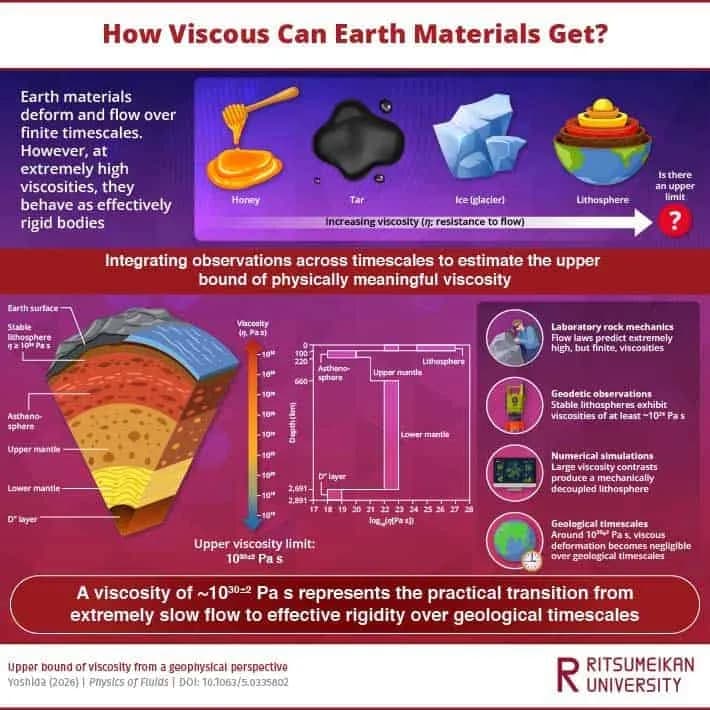
A geophysicist has identified a maximum practical viscosity, establishing a definitive boundary between materials that exhibit fluid-like flow and those that behave as solids. This research, recently highlighted in Physics World, addresses a fundamental question in material science and geophysics regarding how substances transition between states under extreme conditions.
Implications for Earth's History
The identification of this threshold is more than a theoretical milestone; it offers critical insights into the early history of our planet. By understanding the limits of viscosity, scientists can better model the behavior of Earth's mantle and the cooling processes that occurred billions of years ago. This boundary helps explain how the early molten Earth began to stabilize into the structured layers we observe today.
The study suggests that once a material exceeds this specific viscosity limit, its movement becomes so negligible that it effectively ceases to flow on geological timescales. This distinction is vital for researchers studying planetary evolution and the rheology of deep-earth materials.