A New Spectrum of Stellar Death
For decades, the field of astrophysics operated under a standard set of assumptions regarding stellar color. Astronomers generally categorized stars by their temperature: cool stars glowed orange, sun-like stars appeared white, and the most energetic bodies radiated a pale blue. This relationship was viewed as immutable, comparable to the way heating a piece of metal causes it to shift from red to white. However, a groundbreaking study published in RAS Techniques and Instruments has shattered this paradigm, revealing that the dense remnants known as white dwarfs can defy these traditional color laws.
Researchers at the University of Warwick discovered that these dense, dying stars exhibit a surprising "rainbow" of colors—including pink, purple, yellow, and cyan—driven not just by temperature, but by extreme chemical interactions occurring within their high-density atmospheres. By analyzing stellar spectra and mapping these fingerprints onto models of human vision, the team has effectively mapped the true chromaticity of these celestial bodies, proving that the cosmos is far more colorful than previously imagined.
1. The First Green Star: WDJ1330+6435
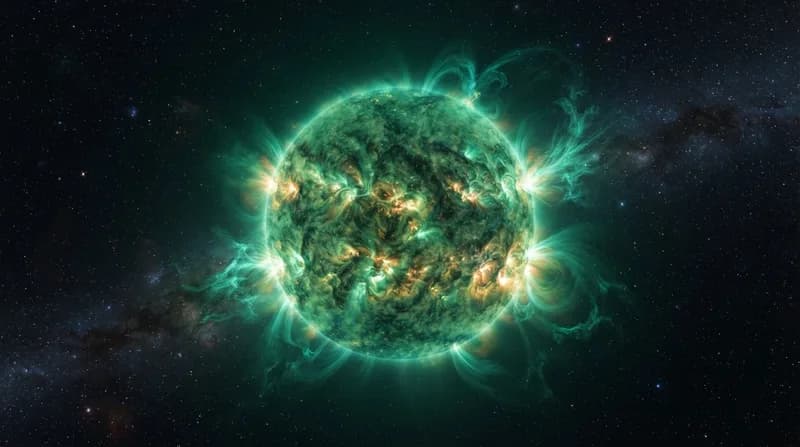
Perhaps the most startling discovery in the study is the identification of WDJ1330+6435, a white dwarf that would appear a striking chartreuse green to the human eye. Located in the Milky Way, this star sits at approximately 4,000 degrees Celsius and features an atmosphere contaminated by rocky debris from its former planetary system, including traces of lithium, calcium, and sodium.
The intense density of the star's atmosphere—roughly 1 gram per cubic centimeter—forces these elements to interact with the surrounding helium plasma in unique ways. Specifically, the sodium present in the atmosphere absorbs light in the orange part of the spectrum, leaving behind a vivid, ghostly green glow. It is the first time a star has ever been confirmed to possess such a hue, effectively bringing a piece of science fiction into reality.
2. The Deep Salmon-Pink of WD J1011+2845
At the opposite end of the newfound color spectrum lies WD J1011+2845, a white dwarf positioned only 48 light-years from Earth. This star has been identified as a candidate for the reddest star ever documented. Its distinct coloration is the result of a deep convection zone that actively pulls carbon from the star’s interior to its surface.
Once this carbon reaches the surface, it alters the wavelengths of the escaping light, shifting nearly all emissions into wavelengths longer than 600 nanometers. This structural chemical process produces an intense, deep salmon-pink appearance. This discovery highlights how internal chemical transport, rather than just surface temperature, plays a critical role in the observable characteristics of post-main-sequence stars.
The Broader Implications
To determine if these colorful anomalies were mere statistical outliers, the team surveyed a representative sample of 151 white dwarfs within 65 light-years of Earth. Their findings suggest that approximately one in every thirty white dwarfs may exhibit non-traditional colors. While this confirms that white remains the median color for the average white dwarf, the sheer number of these stars in the universe implies that millions of oddly colored stellar remnants dot our night sky.
Why it Matters
- Redefining Stellar Classification: The study proves that chemical composition and atmospheric density are as important as temperature in determining a star's appearance.
- Chemical Fingerprinting: These "odd" colors serve as a diagnostic tool, allowing astronomers to identify stars that have ingested their own planetary systems.
- Visual Realism: By applying human vision models to spectral data, researchers can now visualize the universe as it would appear to a human observer, rather than relying solely on raw data plots.