A Breakthrough in Reef Resilience
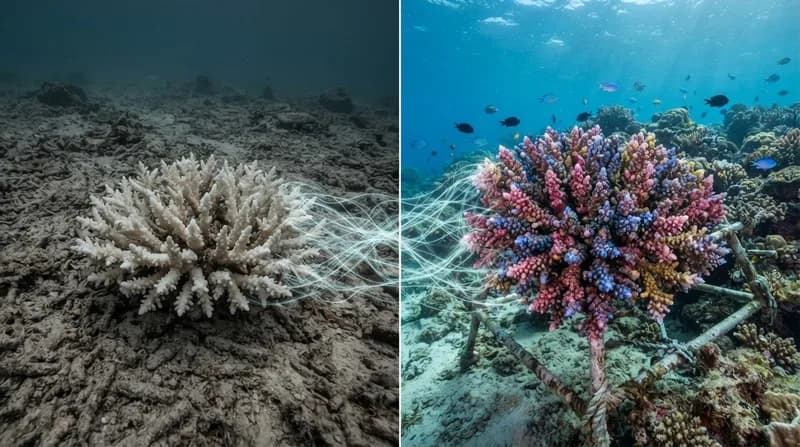
In a significant development for marine conservation, researchers have uncovered a biological lifeline for one of the ocean's most vulnerable inhabitants. A study published in Science Advances reveals that severely bleached corals—often considered on the brink of death due to warming ocean temperatures—can achieve a full recovery within seven weeks simply by coming into contact with healthy, genetically identical coral fragments.
Coral bleaching occurs when rising marine temperatures force corals to expel the essential algae living within their tissues. Without these symbiotic partners, corals lose their vibrant color and their primary source of nutrition, leaving them highly susceptible to decay. While scientists have long sought methods to protect reefs, this discovery offers a new, nature-inspired pathway for restoration that bypasses the typically slow, years-long recovery process.
The Mechanics of Recovery
The discovery began with an accidental observation at the Stanford Hopkins Marine Station, where a researcher noticed a bleached coral fragment regaining its health after falling against a healthy clone in a laboratory aquarium. Intrigued by this, the team designed a controlled experiment using ten pairs of genetically identical coral fragments. In each pair, one fragment was healthy and one was bleached.
When these fragments were placed in direct contact, they performed a remarkable biological feat: their tissues fused. Using advanced microscopy, researchers observed that tiny internal channels aligned, creating a pipeline for beneficial algae and vital nutrients to flow from the healthy donor to the ailing recipient. Remarkably, as little as five days of contact was sufficient to initiate the recovery process, allowing the bleached coral to regain its health completely in just seven weeks.
Why it Matters
- Accelerated Growth: Once introduced, the beneficial algae inside the bleached coral began dividing at a rate ten times faster than that observed in wild populations.
- Genomic Recognition: The fusion process is highly specific; it relies on the coral’s ability to recognize its own genetic material, similar to how human tissue might accept a graft from an identical twin.
- Survival Window: This discovery provides a potential mechanism to help coral colonies survive the immediate aftermath of marine heatwaves, which often prove fatal under current conditions.
Future Implications for Ocean Conservation
While the study provides a promising new tool, the researchers acknowledge that direct physical contact is not currently a scalable solution for vast, open-ocean reefs. The logistics of pairing thousands of individual bleached corals with genetically identical healthy donors remain an immense hurdle. However, the team is already looking toward the future, exploring methods to deliver concentrated doses of beneficial algae directly to damaged colonies without requiring physical fusion.
If researchers can successfully replicate this transfer process on a larger scale—perhaps by introducing cultured algae directly to stressed reefs after a heatwave—it could provide a much-needed buffer against the accelerating impacts of climate change. As the scientific community works to refine these techniques, the focus remains on keeping reefs stable long enough for them to reproduce and naturally recruit new colonies, ensuring the long-term survival of these vital marine ecosystems.