A Slow-Motion Tectonic Derailment
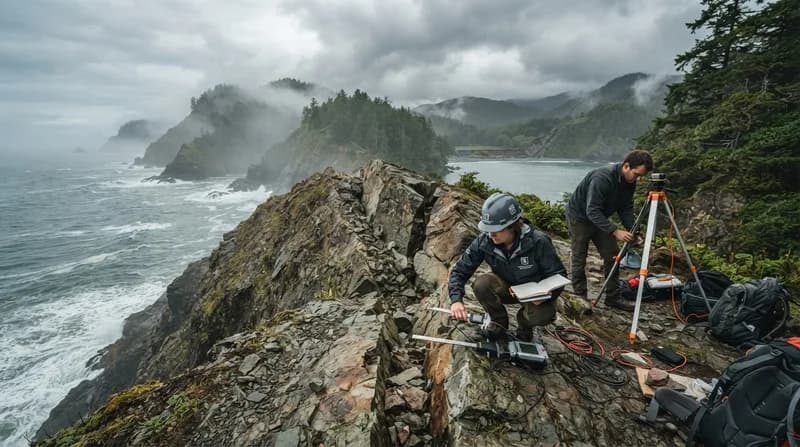
In a discovery that challenges our understanding of how continents evolve, researchers have successfully imaged a tectonic subduction zone in the Pacific Northwest as it undergoes a dramatic, slow-motion disintegration. By utilizing advanced seismic reflection data collected during the CASIE21 experiment, geologists have essentially captured a 'snapshot' of a massive tectonic system in its final stages. The Cascadia subduction zone, where the Juan de Fuca and Explorer plates are forced beneath the North American plate, is revealing that these geological powerhouses do not cease activity in a single, catastrophic event, but rather fall apart in a gradual, piecewise manner.
Led by a team from Louisiana State University, the study indicates that the process is akin to a train derailment occurring one carriage at a time rather than a sudden, total collapse. The team employed sound waves to generate high-resolution imagery of the subducting plate, uncovering a series of massive faults and fractures that are actively segmenting the slab. This revelation of 'episodic termination' suggests that the tectonic plate is being dismantled by localized transform boundaries that act like geological scissors, slicing the crust into independent microplates.
The Anatomy of the Tear
The findings center on a 75-kilometer-long tear identified beneath the seafloor off the coast of Vancouver Island. Within this zone, researchers observed a staggering offset where a segment of the oceanic crust has dropped by roughly five kilometers. This physical rift is not merely a static feature; it is an active structural break that is changing the dynamics of the entire region. The absence of seismic activity in specific areas along this tear serves as a key indicator that sections of the plate have already detached from the main mass, no longer subject to the stress that typically generates earthquakes.
This ongoing detachment creates significant implications for our understanding of mantle dynamics. As portions of the plate snap off and submerge, they leave behind 'slab windows'—gaps that allow hotter mantle material to rise toward the surface. This phenomenon provides a plausible explanation for the unusual volcanic activity and shifting magma patterns observed by geologists in the geological record. By matching these modern observations with ancient, fragmented plate remains found elsewhere, such as off the coast of Baja California, scientists can now reconstruct the final acts of long-vanished subduction systems with unprecedented accuracy.
Why it Matters
- Reframing Geological History: The discovery solves long-standing mysteries regarding 'fossil' microplates and explains how the Earth preserves evidence of ancient, dismantled tectonic systems.
- Model Improvement: By integrating these identified fractures and microplates into current seismic models, researchers hope to better predict how future earthquake ruptures might behave when encountering these disrupted boundaries.
- Volcanic Insights: The formation of 'slab windows' offers a clearer link between the life cycle of subduction zones and the intermittent volcanic eruptions that shape our planet’s surface.
Outlook and Implications
While the prospect of a major tectonic system 'tearing apart' may sound alarming, experts caution that this process is measured in millions of years. This discovery does not imply a change in the immediate earthquake risk for the Pacific Northwest, as the region remains subject to the powerful, human-timescale seismic hazards inherent to the Cascadia subduction zone. Instead, the research provides a vital long-term view of Earth's evolution. As we continue to refine our seismic imaging technologies, the ability to observe the 'death' of a tectonic system offers a rare look at the fundamental geological forces that continually reshape our world, one piece at a time.