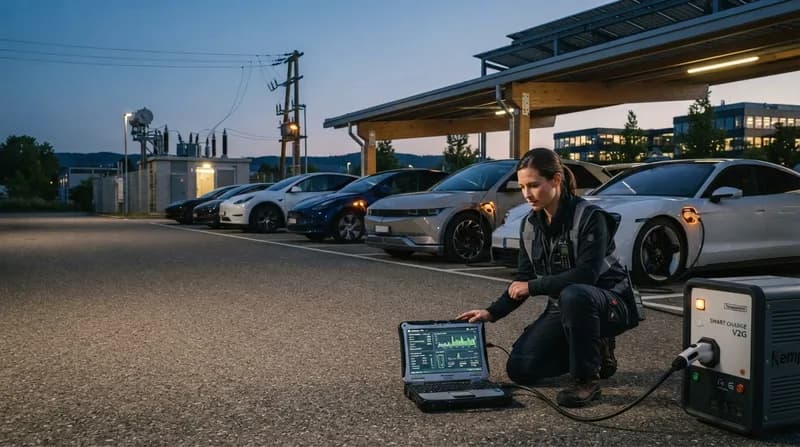
Turning Service Vans into Grid Assets
The energy transition is gaining a powerful new ally: the humble electric delivery van. Enercity, in collaboration with Volkswagen Commercial Vehicles, has successfully transitioned a fleet of twelve ID. Buzz electric vans from standard transport workhorses into an active virtual power plant (VPP). By utilizing vehicle-to-grid (V2G) technology, these vehicles are not just consuming energy; they are actively feeding electricity back into the public grid and generating revenue in the process.
The pilot, based in Hanover, serves as a high-stakes proving ground for bidirectional charging. After months of "shadow trading" to test the software and network stability, the project has officially recorded its first revenue. While the initial earnings remain modest, the technical achievement is monumental. It demonstrates that when aggregated, a commercial fleet possesses the capacity—in this case exceeding 0.1 megawatts—to function as a reliable, flexible storage resource for the energy market.
The Road to Scalability
While the hardware for bidirectional charging is largely ready for prime time, the shift toward widespread adoption faces a significant hurdle: bureaucracy. Maximiliane von Butler, Head of Energy Innovation at Enercity, emphasizes that the bottleneck is no longer found in the vehicles or the chargers, but within the complex digital infrastructure of the energy sector. The primary challenge remains the standardized measurement, billing, and balancing of mobile energy storage across various grid operators.
To solve this, industry players are looking toward frameworks like the "MiSpeL" working paper, which aims to provide clarity on how charging and discharge processes should be handled. With over 700 grid operators in Germany alone, synchronizing the billing and metering infrastructure is a massive logistical undertaking. However, the momentum behind the "Coalition of the Willing on Bidirectional Charging" suggests that policymakers and industry leaders are aligning to turn these pilot projects into standardized, scalable services.
Why It Matters
- Flexibility as a Product: V2G transforms electric vehicles from passive consumers into active grid participants, helping balance the volatility of renewable energy sources.
- Commercial Viability: By aggregating vehicles into a VPP, companies can offset fleet ownership costs through energy market participation.
- Reducing Grid Stress: Widespread bidirectional charging could significantly reduce the need for massive, costly grid expansions by utilizing existing battery assets to smooth out demand peaks.
- Economic Incentive: Moving beyond simple charging, V2G turns vehicle downtime into a revenue-generating opportunity for business fleets.
Looking Toward the Five-Year Horizon
The transition from experimental trials to commercial product offerings is expected to accelerate rapidly. Enercity envisions a future where V2G-enabled fleet management software is a standard utility for business customers. As dynamic, price-optimized charging (V1G) becomes a staple of current smart-charging applications, the jump to full bidirectional V2G represents the next evolutionary step in EV integration.
Within the next five years, the industry expects that vehicle-to-grid capabilities will be as common as home-charging stations are today. By treating EVs as mobile, decentralized energy storage units, energy providers like Enercity are essentially building a more resilient, cost-effective, and sustainable power grid without needing to build as much traditional, carbon-heavy infrastructure.