ScienceTechnical Deep Dive

Fossilized Feces Reveal Why Modern Birds Survived the Great Extinction

Published
EElectricBuzz Editorial Team
Fossilized Feces Reveal Why Modern Birds Survived the Great Extinction
3 min read515 wordsElectricBuzz Editorial Team

The Gist

A remarkably preserved feather found inside 66-million-year-old dinosaur dung provides a missing piece of the puzzle regarding avian survival during the K-Pg extinction.

A New Frontier in Paleontology: The Coprolite Cache

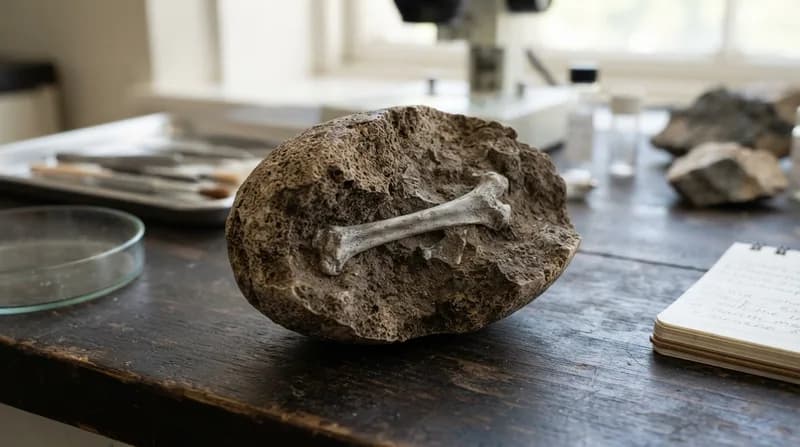
In a discovery that sounds more like a forensic crime scene investigation than a traditional excavation, paleontologists have identified a pristine, 66-million-year-old feather preserved within fossilized dinosaur dung—a coprolite. Unearthed in the Hell Creek Formation of Montana, this unexpected time capsule contains the remains of a hesperornithiform, an extinct aquatic bird. Using advanced micro-CT scanning technology, researchers were able to look past the external surface of the fossilized waste to reveal a treasure trove of biological data, including scales from a gar fish and the delicate, structural remains of avian plumage.

Led by the Field Museum’s Jingmai O'Connor, the research team utilized CT scanning to visualize the specimen without damaging it. This breakthrough not only provides the first-ever look at hesperornithiform feathers but also suggests that museums around the world may be sitting on a goldmine of prehistoric data hidden within their collections of fossilized excrement. By moving beyond skeletal remains, scientists are now peering directly into the dietary habits and biological adaptations of creatures living in the final days of the Cretaceous Period.

Plumage and the Impact Winter Hypothesis

The core mystery being addressed by this study is the selective survival of the Neornithes lineage—the ancestors of every modern bird—during the mass extinction triggered by the asteroid impact. While it has long been hypothesized that aquatic habitats might have provided a refuge from the ensuing "impact winter," the discovery of these feathers complicates that narrative. The hesperornithiforms, which were also adapted to aquatic lifestyles similar to modern loons, perished alongside most other dinosaur lineages, suggesting that location alone was not the deciding factor in their extinction.

The study proposes a radical alternative: the evolution of feather insulation. The feathers identified in the coprolite represent a mix of modern-looking, waterproof structures and more primitive, fuzzy body feathers typically seen in non-avian dinosaurs. Researchers believe the Neornithes possessed a more sophisticated, efficient insulation system compared to other Cretaceous bird groups. As the asteroid collision blanketed the planet in dust and debris, causing global temperatures to plummet, those birds with superior heat-trapping plumage likely possessed a critical evolutionary advantage, allowing them to endure the harsh conditions that wiped out their less-insulated contemporaries.

Why it Matters

  • Beyond Skeletons: The research validates coprolites as legitimate, high-value scientific archives, often containing soft tissues and materials that don't survive standard fossilization.
  • Thermal Efficiency: This study bridges the gap between plumage evolution and survival, pointing to biological cold-weather adaptation as a key factor in the survival of modern birds.
  • Ecological Insight: By identifying both prey (gar fish) and the predator's meal remnants (the bird), the fossil provides a vivid snapshot of a 66-million-year-old food web, highlighting the predatory habits of large theropod dinosaurs during their final days on Earth.

As this line of research progresses, the shift toward studying fossilized remains with non-destructive imaging could revolutionize our understanding of how ancient organisms interacted with their environments. The findings, published in the journal Current Biology, serve as a reminder that the most significant secrets of history are often hidden in the most humble—and unlikely—of places.


The 5 Best Over-Ear ANC Headphones of 2026, Tested & Ranked
Editor's Pick Guide
92/100
Tech & Gadgets12 min read

The 5 Best Over-Ear ANC Headphones of 2026, Tested & Ranked

We locked five over-ear ANC picks for 2026 — Sony WH-1000XM6, Bose QuietComfort Ultra 2, Soundcore Space One, Sennheiser Momentum 5, and Apple AirPods Max 2 — then stress-tested them on lab metrics, long-term owner truth, and live street prices.

Related Stories

Semantically matched articles, ranked by topic overlap and freshness.

NASA's Roman Space Telescope Set for Two Decades of Cosmic Discovery
Science

NASA's Roman Space Telescope Set for Two Decades of Cosmic Discovery

Thanks to exceptional launch precision and significant fuel savings, the Nancy Grace Roman Space Telescope is poised to more than double its mission life, potentially operating for over 22 years.

Unlocking Predictive Markers: How B Cells Could Forecast Immunotherapy-Induced Colitis
Science

Unlocking Predictive Markers: How B Cells Could Forecast Immunotherapy-Induced Colitis

New research from MD Anderson Cancer Center suggests that B cell activity acts as a crucial early-warning system for identifying patients at risk of developing severe colitis during cancer treatment.

Could a Tiny Brain Protein Be the Master Switch for Aging?
Science

Could a Tiny Brain Protein Be the Master Switch for Aging?

Researchers have identified that declining levels of a brain protein called Menin may drive systemic aging, offering a potential new target for age-related health interventions.

Challenging Einstein: Scientists Pioneer Gravity Tests Using Exotic Muonium Atoms
Science

Challenging Einstein: Scientists Pioneer Gravity Tests Using Exotic Muonium Atoms

Researchers at ETH Zurich have developed a method to create controlled beams of muonium, potentially enabling the first-ever gravitational tests on second-generation particles.

Unlocking the Narrative: AI System Transforms Physician Notes into Actionable Medical Data
Science

Unlocking the Narrative: AI System Transforms Physician Notes into Actionable Medical Data

A groundbreaking study reveals how a new AI system can parse clinical prose at scale, converting hidden patient insights into verifiable, computer-readable data.

Caltech’s Femtosecond Breakthrough: Steering Light with Light
Science

Caltech’s Femtosecond Breakthrough: Steering Light with Light

Researchers have engineered a nanoscale silicon metasurface capable of redirecting light beams in just 74 quadrillionths of a second, shattering traditional speed barriers in photonic computing.

Beyond the Starch: Why Black and Green Rice Are Emerging as Metabolic Superfoods
Science

Beyond the Starch: Why Black and Green Rice Are Emerging as Metabolic Superfoods

New research from Hokkaido University reveals that pigmented rice varieties contain unique, beneficial fats that could revolutionize dietary approaches to blood sugar management.

Biological Breakthrough: Scientists 3D-Print a Functional Human Gut-on-a-Chip
Science

Biological Breakthrough: Scientists 3D-Print a Functional Human Gut-on-a-Chip

Researchers at Lawrence Livermore National Laboratory have successfully replicated the complex 3D architecture of the human small intestine on a compact, microfluidic device.