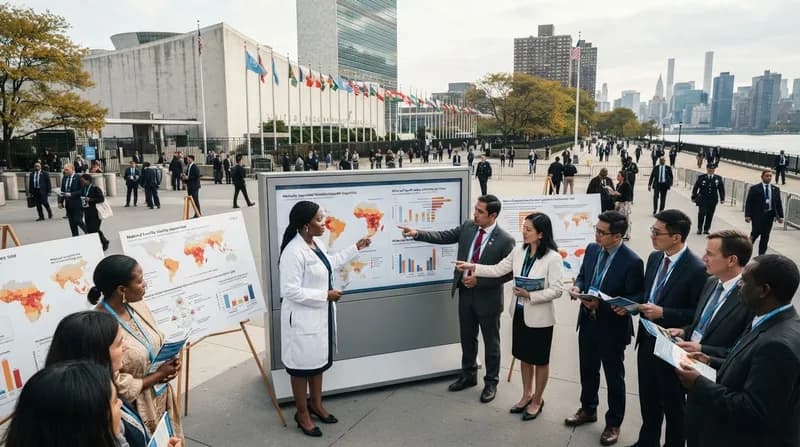
A Critical Juncture for Global Health
As international leaders convene for the 81st session of the United Nations General Assembly (UNGA 81), a dire warning has emerged from the scientific community regarding the future of sexual and reproductive health and rights (SRHR). A newly published collection of seven articles in The BMJ, developed in collaboration with the CUNY Graduate School of Public Health & Health Policy, highlights an alarming convergence of political and financial pressures that threaten to dismantle established health infrastructure worldwide.
At the center of the controversy is a proposed administrative merger between U.N. Women and the U.N. Population Fund (UNFPA). Experts argue that consolidating these independent mandates would dilute their focus and weaken the global commitment to gender equality. By integrating these critical bodies, proponents of the status quo believe the U.N. risks losing the specialized advocacy necessary to address complex issues such as maternal healthcare, contraceptive access, and reproductive justice in a shifting geopolitical climate.
The Financial and Political Headwinds
The collection draws attention to a staggering decline in official development assistance, which has plummeted by an estimated 46% between 2024 and 2026. In her editorial contribution, Chelsea Clinton highlights the direct, life-altering consequences of these fiscal cuts. Projections indicate that the reduction in U.S. support alone could potentially lead to 40–55 million unintended pregnancies and between 12–16 million unsafe abortions across 51 nations.
Beyond immediate funding issues, the authors identify a broader crisis in global governance and an expanding movement that actively opposes established reproductive rights. The research suggests that the current international fiscal architecture is ill-equipped to handle these challenges, necessitating a comprehensive reimagining of how multilateral organizations coordinate, fund, and deliver essential health services to the most vulnerable populations.
Key Focus Areas of the Research
- Multilateral Reform: Experts call for the protection of independent mandates for U.N. agencies, resisting mergers that threaten to sideline human rights commitments.
- Civil Society Resilience: New strategies for grassroots organizations are detailed, showing how local actors can resist anti-rights mobilization even in hostile political environments.
- Regional Resistance Models: Case studies, particularly from New York state, provide a blueprint for how sub-national governments can bypass federal regression to secure reproductive health access.
- Fiscal Accountability: The articles demand a transparent international financial framework that prioritizes equitable health outcomes over political expediency.
Why It Matters
The health of a global society is inextricably linked to the agency individuals have over their own reproductive lives. When access to prenatal care, birth education, and family planning is restricted, the repercussions extend into economic stability, gender equity, and public health infrastructure. The consensus among these experts is that the international community must pivot away from austerity and toward resilient, accountable systems that treat reproductive rights as a fundamental human necessity rather than a negotiable political line item. As the U.N. General Assembly continues its sessions, these findings serve as a stark reminder that institutional inertia can be just as damaging as active opposition to human rights.