A New Chapter for Heavy-Duty Hydrogen
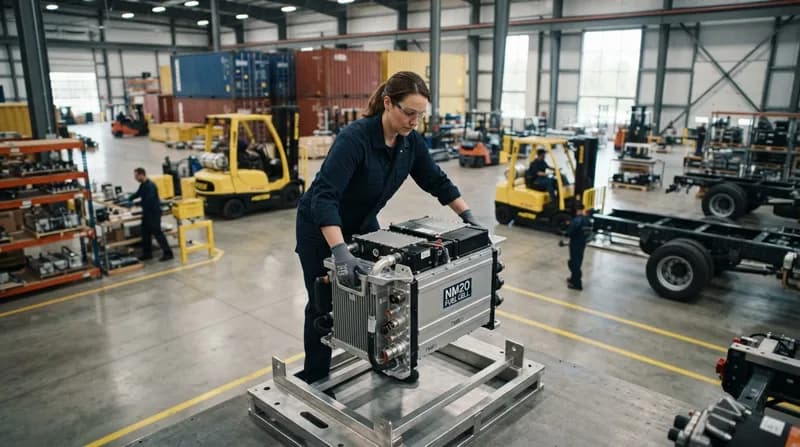
At the 2026 IAA Transportation expo in Hanover, EKPO Fuel Cell Technologies—the joint venture between ElringKlinger and OPmobility—has unveiled the latest iteration of its flagship NM20 fuel cell stack. Two years after the platform's initial debut, this new evolution marks a significant push toward the industrialization of hydrogen-based powertrains. By refining the stack, module interfaces, and manufacturing processes into a fully integrated system, EKPO is aiming to make hydrogen power more accessible and reliable for the most demanding heavy-duty applications, including commercial trucking, rail, and maritime transport.
The engineering team has overhauled the architecture from the bipolar plate to the outer housing. This redesign is explicitly aligned with large-scale industrial manufacturing, emphasizing improved automatability, better quality control, and rigorous traceability. By standardizing components across the platform, the company is positioning the NM20 as a versatile toolkit that can be rapidly scaled for various power requirements.
Refined Engineering and Reduced Footprint
The most immediate advancements in the new NM20 are found in its physical footprint. EKPO has achieved a roughly 20 percent reduction in total module volume, a critical update for engineers looking to fit advanced fuel cell hardware into tight chassis constraints. Weight reduction is equally impressive: the fully assembled module now weighs 178 kilograms, shedding 39 kilograms compared to previous iterations. Even more notable is the 25 percent reduction in weight for the Cell Row Assembly, the active stack block that serves as the engine of the system.
Integration complexity—a frequent hurdle for hydrogen vehicle manufacturers—has also been addressed. The updated NM20 directly incorporates vital functions such as water separation, media distribution, sensor monitoring, and high-voltage connections into the stack architecture. By offloading these auxiliary tasks into the stack itself, EKPO simplifies the overall system design for original equipment manufacturers (OEMs).
Technical Performance and Power Spectrum
- Single-Stack Configuration: Features 323 cells, providing over 200 kW of power.
- Max Variant: Delivers output exceeding 300 kW.
- Twin-Stack Module: Features 646 cells, generating over 400 kW of continuous power.
- Operating Parameters: Supports operating pressures up to 3.0 bara with efficiency levels ranging between 56 and 69 percent.
- Durability: Designed for an operational lifespan of 25,000 hours.
Outlook and Strategic Backing
Beyond its road-going potential, the NM20’s ability to operate at temperatures up to 95°C makes it a strong candidate for stationary energy storage and backup power generation. This versatility is bolstered by significant financial support; the development is backed by a €177 million grant from the European IPCEI (Important Project of Common European Interest) funding program. As EKPO continues its collaboration with partners like Akkodis to test this tech in 40-tonne demonstration trucks, the firm is setting a clear pace for the decarbonization of heavy logistics, moving from experimental prototypes to a standardized, modular industrial product.