A New Window Into the Cosmos
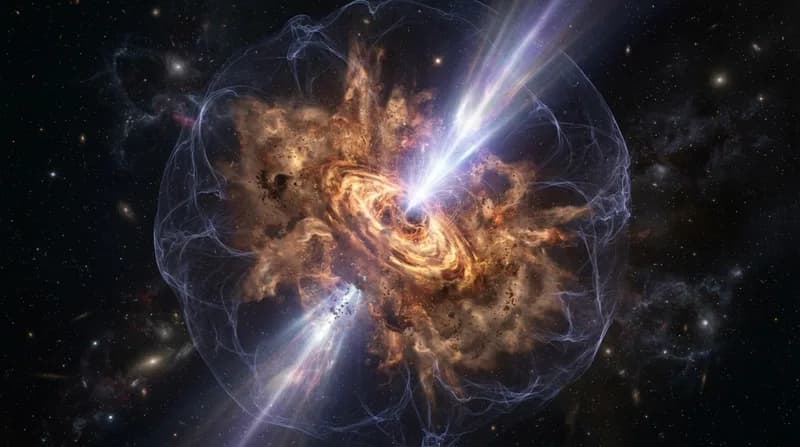
For decades, astronomers have relied on the blinding flashes of gamma-ray bursts (GRBs) to track the most violent events in the universe: the collision of two compact objects, such as neutron stars. These mergers typically present as a short, intense explosion, providing a brief window for telescopes to capture data before the signal fades. However, the Einstein Probe (EP) has recently fundamentally changed this narrative by identifying a previously hidden, long-lasting phase of activity that follows these cataclysmic events.
The discovery centers on an event labeled EP250704a, which occurred on July 4, 2025. While traditional gamma-ray detectors captured the initial, sub-second flash, the Einstein Probe’s wide-field soft X-ray monitoring capabilities tracked the event for nearly ten minutes after the initial burst had subsided. This extended emission, which remained invisible to conventional, narrow-field X-ray telescopes that require precise pre-alerts, offers a new, detailed look at the aftermath of stellar mergers.
The Magnetar Connection
Researchers analyzing the data suggest that the prolonged X-ray activity is not merely leftover debris from the explosion, but rather the result of a powerful 'central engine' created by the merger. The primary hypothesis is that the collision birthed a magnetar—a highly magnetized, rapidly rotating neutron star. This newborn entity continued to inject energy into the surrounding space long after the initial blast, accounting for the unique spectral signatures observed by the Einstein Probe.
This finding is significant because it provides a direct look at the physics governing the remnant left behind by neutron star mergers. By analyzing the evolution of the brightness and the specific soft X-ray spectrum, scientists can now begin to constrain the neutron star equation-of-state, which describes how matter behaves under the extreme pressures found within these dense stellar cores. Previous missions simply lacked the sensitivity and field of view to catch these extended signatures, effectively leaving a "blind spot" in our observational history.
Implications for Multi-Messenger Astronomy
The success of the Einstein Probe marks a major milestone in the era of multi-messenger astronomy, where gravitational waves and electromagnetic radiation are synthesized to provide a complete picture of cosmic phenomena. Since the first joint detection of a neutron star merger in 2017, the scientific community has been racing to identify new electromagnetic counterparts to gravitational-wave sources. The soft X-ray component discovered by the EP team serves as a vital new probe for this purpose.
- Extended Observation: Unlike previous missions that focused on the initial gamma-ray flash, the EP tracked continuous X-ray emissions for 10 minutes.
- Central Engine Evidence: The data strongly supports the formation of a highly magnetized neutron star (magnetar) as the driver of the extended activity.
- Spectral Insight: The 'soft' nature of the X-ray spectrum explains why prior narrow-field telescopes were unable to detect this secondary phase.
- Multi-Messenger Utility: This new signal provides astronomers with a reliable electromagnetic counterpart that can be cross-referenced with future gravitational-wave detections.
Looking ahead, this discovery suggests that short gamma-ray bursts are far more complex than originally thought. The research team posits that similar extended X-ray activity might be a common feature of these mergers, potentially hiding in plain sight. As the Einstein Probe continues its mission, it is poised to uncover further transient phenomena that will continue to challenge and refine our models of the extreme universe.