The Efficiency Gap: VW vs. Renault
In the evolving landscape of compact electric mobility, the Volkswagen ID. Polo and the Renault 5 E-Tech represent two of the most significant entries. While both vehicles are designed for the urban environment, a recent long-distance road trip conducted during the Eurocharge event provided a unique look at how these machines handle highway miles and varied topography. Despite featuring nearly identical 52-kWh usable battery capacities, the two hatchbacks delivered distinct real-world results that highlight how software, aerodynamics, and thermal management dictate the true road-trip experience.
1. The Volkswagen ID. Polo
The Volkswagen ID. Polo emerged as the efficiency leader during the trek from Hungary to Austria. Covering a challenging route comprised of 80% highway and 20% mountain terrain, the ID. Polo achieved a consumption rate of 17.2 kWh/100 km (approximately 3.61 miles/kWh). This efficiency advantage allowed it to extract more distance from its 52-kWh pack, with calculations placing its usable range at roughly 188 miles compared to its counterpart.
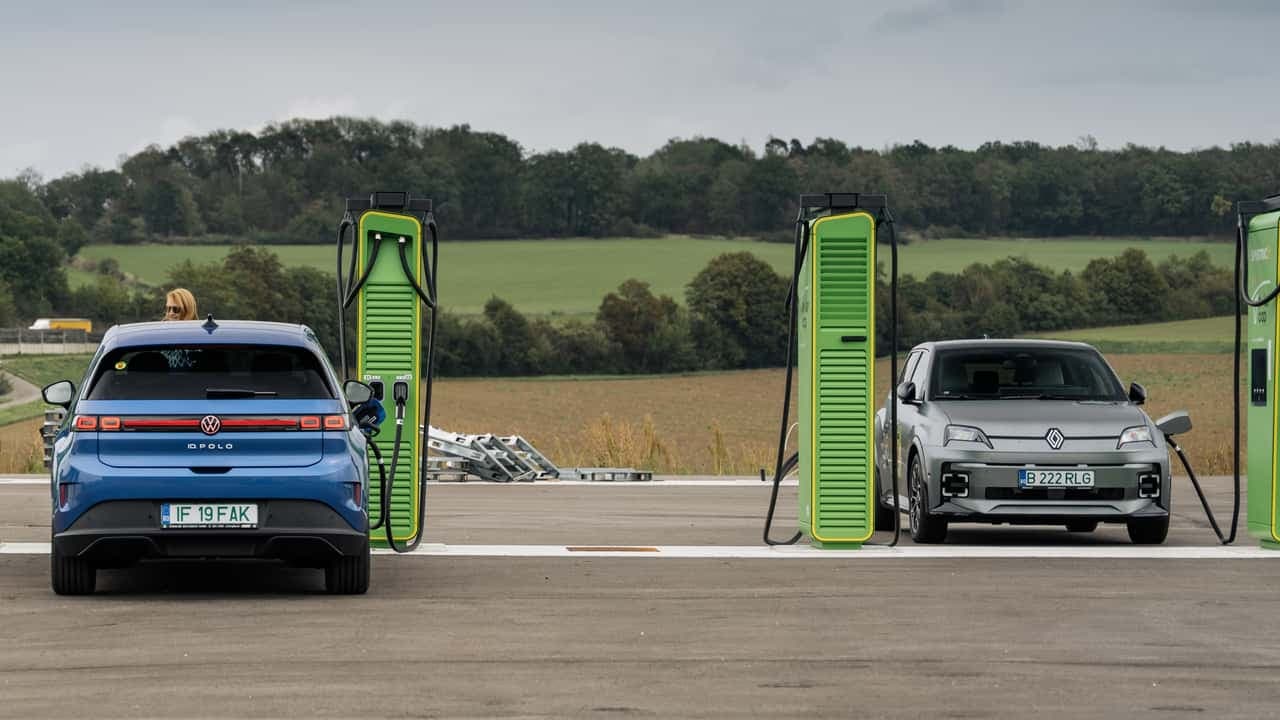
Beyond raw range, the ID. Polo demonstrated superior charging behavior. It features a peak DC fast-charging capacity of 105 kW. During the trip, the vehicle spent significantly less time tethered to charging stations, logging a total of 77 minutes over the course of the journey. Its ability to maintain a consistent charging curve—officially rated to go from 10% to 80% in about 24 minutes—makes it a more compelling candidate for drivers who frequently embark on longer highway excursions.
2. The Renault 5 E-Tech
The Renault 5 E-Tech, while slightly less efficient in this specific test, remains a standout in the compact EV segment for its design and driver-focused personality. In the same test conditions, the R5 recorded a consumption rate of 18.2 kWh/100 km (roughly 3.41 miles/kWh). This 5.5% difference in consumption, while marginal in day-to-day city commuting, translated into a calculated highway range of approximately 178 miles.
Charging performance for the R5 is respectable, peaking at 100 kW. However, throughout the road trip, the vehicle logged 102 minutes at charging stops, including a session where it required 60 minutes to replenish from 23% to 100%. While the R5 offers a slightly slower charging curve than the ID. Polo—officially requiring 30 minutes to reach an 80% state of charge from 15%—it remains a highly competitive and beloved option for those who prioritize the retro-modern aesthetic and overall driving dynamics over absolute charging speed.
Why It Matters
This comparison serves as a reminder that identical battery specifications are only part of the story when evaluating an electric vehicle. Factors such as the efficiency of the power inverter, the vehicle's drag coefficient, and the robustness of the battery thermal management system play decisive roles in how a car performs on the open road. As EV manufacturers shift focus toward optimizing these hidden software and mechanical variables, the gap between "city-only" EVs and "road-trip-capable" EVs continues to narrow.
Outlook and Implications
For potential buyers, these findings suggest that the choice between compact electric hatchbacks often comes down to the intended use case. Drivers who prioritize highway range and faster charging stops will likely favor the engineering approach taken by Volkswagen, while those prioritizing design and city maneuverability will find the Renault 5 a compelling, stylish alternative. As charging infrastructure matures, the difference in charging sessions may become less noticeable, but for now, the data confirms that efficiency remains the final frontier in making EVs fully comparable to internal combustion vehicles.