A Mythical Discovery in the Deep
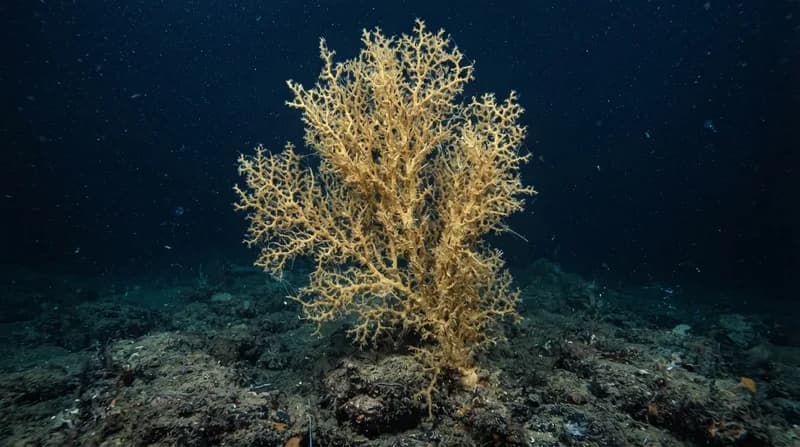
In the uncharted depths of the Pacific Ocean, roughly 360 to 529 meters below the surface, researchers have identified a breathtaking biological anomaly. During expeditions conducted in 2019 and 2023 near Costa Rica's Isla del Coco, the remotely operated vehicle (ROV) SuBastian captured footage of a striking, bright yellow coral. Standing over a meter tall, these colonies rise from the rocky seafloor, creating a visual spectacle that researchers found impossible to ignore.
The habitat surrounding these corals is equally remarkable. The rocky outcrops are blanketed in dense populations of brittle stars, which, when viewed alongside the vivid, branching coral, resemble a forest of glowing trees set against a glittering, stellar backdrop. This ethereal landscape prompted the research team to bestow the name Laurinque elenya upon the find. Derived from J.R.R. Tolkien’s Elvish language, Quenya, 'Laurinque' translates to 'golden tree,' while 'elenya' refers to the stars, perfectly capturing the mystical essence of this deep-sea ecosystem.
The Taxonomic Challenge
Classifying the coral proved to be an exercise in frustration. Initially, the research team, led by Dr. Odalisca Breedy of the Universidad de Costa Rica, attempted standard genetic sequencing of three common marker genes. However, the results were contradictory; each gene pointed toward a different, unrelated family, suggesting that the organism did not fit into the established biological taxonomy of corals.
To solve the mystery, the scientists employed phylogenomics, a sophisticated analysis that evaluates hundreds of genes simultaneously. The data confirmed what the team suspected: Laurinque elenya represents a unique evolutionary lineage. While it shares distant traits with the family Eunicellidae, its anatomical structure and genetic markers are distinct enough that the researchers established an entirely new family, Laurinqueidae, and a new genus, Laurinque, to formally classify the species. The findings, published in the journal ZooKeys, serve as a testament to how little we still know about the biodiversity hidden within the deep ocean.
Why It Matters
- Redefining Biodiversity: The discovery of an entirely new family of coral underscores the immense, cataloged, and uncataloged biodiversity existing in the deep sea.
- Ecosystem Preservation: These coral gardens function as complex, three-dimensional architectures that provide essential habitats for various deep-sea organisms, marking them as vital hotspots for marine life.
- Technological Frontiers: The use of high-tech ROVs like SuBastian and advanced phylogenomic sequencing allowed scientists to uncover evolutionary secrets that would have remained hidden using traditional 20th-century exploration methods.
- Scientific Stewardship: As these environments are considered vulnerable, the identification of such distinct lineages highlights the urgent need for continued conservation efforts in oceanic regions that remain poorly explored.
An Expanding Frontier
The discovery of the 'golden tree' coral is part of an ongoing effort to map the life forms dwelling on Costa Rica's seamounts. These underwater mountains act as islands of life in the deep ocean, supporting complex communities that thrive in the cold, pressurized depths. The international collaboration, which included support from the Schmidt Ocean Institute and the National Geographic Society, emphasizes that our exploration of the ocean floor—which covers two-thirds of the planet—is still in its infancy. As researchers continue to analyze samples and survey new sites, the scientific community anticipates that Laurinque elenya will be just one of many breakthroughs in our understanding of marine evolution.