A New Frontier in Galactic Observation
For years, the study of dark matter—an invisible substance that accounts for roughly 85 percent of the mass in our universe—has been limited by our inability to observe it directly. Instead, astronomers rely on gravitational influence to map its distribution. A breakthrough published in the journal Nature has now expanded this toolkit by identifying the first-ever globular cluster stellar stream outside the Milky Way, marking a pivotal moment in observational cosmology.
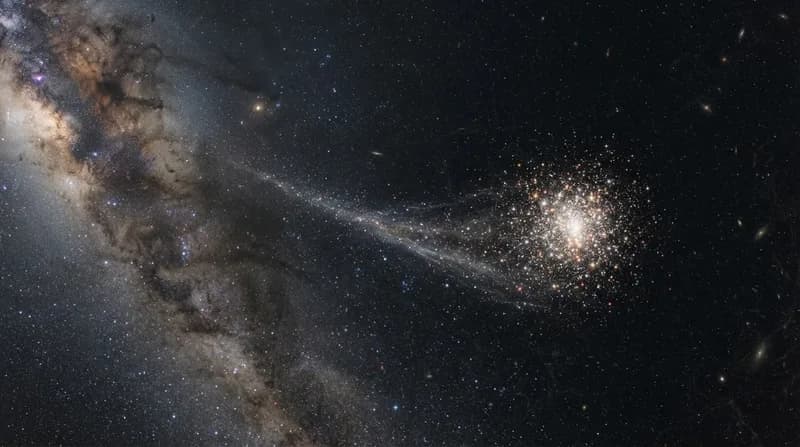
Led by PhD student Julie Kiel Holm of the Niels Bohr Institute and Associate Professor Sarah Pearson of DTU Space, the research team identified a faint, elongated trail of stars within an ultra-diffuse galaxy known as UGC9050-Dw1. These streams are formed through "tidal stripping," where the immense gravity of a host galaxy slowly pulls stars away from a dense globular cluster, leaving a visible ribbon of stars in its wake. By analyzing the shape and motion of these trails, scientists can essentially map the invisible gravitational architecture shaped by dark matter.
Why Stellar Streams Matter
Until now, our understanding of these celestial ribbons was confined exclusively to our own galaxy. The ability to detect these structures in distant, low-light environments is a technical triumph. Because globular cluster stellar streams are exceptionally faint, they have long been considered "ghostly" features that are nearly impossible to resolve. However, the application of advanced data analysis on massive astronomical datasets has allowed researchers to isolate these signals even in the depths of ultra-diffuse galaxies.
The implications for cosmology are profound. By demonstrating that this method works beyond the local neighborhood, researchers can now apply it to a wide variety of galactic structures. This allows for a more comparative approach to dark matter studies, moving away from relying on a single, local example and toward a comprehensive, universal model of how dark matter influences galactic evolution.
Key Implications for Future Research
- Broadened Scope: Previously, dark matter mapping via stellar streams was limited to the Milky Way; this discovery validates the technique for distant galaxies.
- Enhanced Precision: Researchers successfully constrained both the dark matter halo mass and density profile for UGC9050-Dw1, proving the method's efficacy in real-world application.
- Observational Synergy: The findings pave the way for upcoming data from next-generation instruments like the Euclid and Nancy Grace Roman Space Telescopes to revolutionize our map of the invisible universe.
As astronomers continue to refine their detection methods, the inventory of known stellar streams is expected to grow significantly. This growth will provide the empirical data necessary to test competing theories about dark matter, ultimately helping to answer one of the most enduring questions in modern physics: what constitutes the vast majority of the matter in our cosmos.