The Foundation of Modern Cosmology Under Fire
For over two decades, the scientific community has operated under the consensus that the universe is not just expanding, but that its rate of expansion is accelerating. This concept, largely attributed to the mysterious influence of 'dark energy,' earned a Nobel Prize and has served as a cornerstone of modern astrophysics. However, a provocative new study published in the Monthly Notices of the Royal Astronomical Society is challenging the very data used to justify this cosmic acceleration.
Led by Professor Subir Sarkar of the University of Oxford and researchers at the Tata Institute of Fundamental Research, the study re-examines the 'Pantheon+' dataset—a gold-standard collection of observations comprising over 1,700 Type Ia supernovae. These stellar explosions have long acted as 'standard candles' for cosmologists, allowing them to measure the distance and speed of remote galaxies. By introducing a new correction factor related to the age of the progenitor stars, the research team claims that previous interpretations of these events may be fundamentally misaligned with reality.
The Progenitor Age Correction
The core of the argument lies in the evolution of stars. Type Ia supernovae are the results of white dwarfs reaching a critical mass, but the characteristics of these explosions are influenced by the age and environment of their host stars. The research team posits that failing to account for these environmental variables leads to an overestimation of the universe's expansion rate.
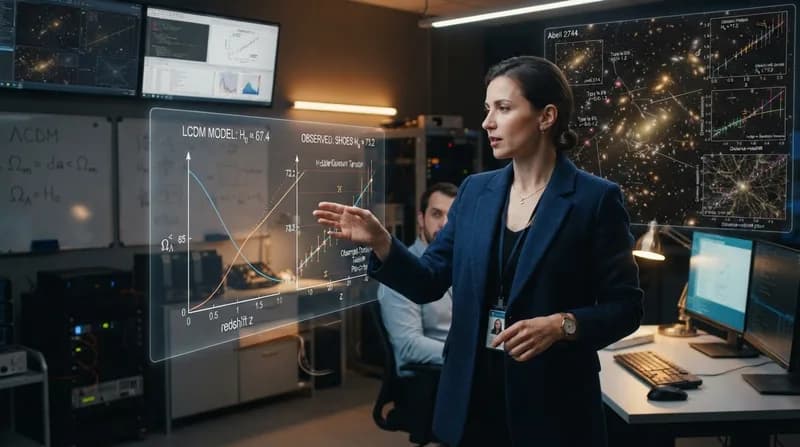
When the researchers applied their updated correction factor to the Pantheon+ data, the results were striking: they no longer detected a universe in uniform acceleration. Instead, the data suggests that cosmic expansion might actually be decelerating. This shift would fundamentally rewrite our understanding of the universe's evolution, potentially rendering the need for 'dark energy' entirely obsolete.
Anisotropy and the Direction of Expansion
Beyond the age of stars, the study introduces another hurdle for the standard cosmological model: anisotropy. The standard model of the universe assumes that on a massive scale, the cosmos behaves identically regardless of the direction one looks. However, the researchers found that the apparent acceleration measurements vary significantly depending on the direction of the observer.
The study argues that if the observed expansion appears to change based on direction, dark energy—typically modeled as a uniform property of the quantum vacuum—cannot be the driver. They suggest the apparent effect aligns closely with our local movement in the cosmos, potentially implying that what we have interpreted as universal acceleration is actually an artifact of our specific trajectory through space rather than a fundamental property of the universe itself.
The Road to Verification
The scientific community is currently split on the findings, with other experts, including Professor Maria Vincenzi, continuing to argue that the prevailing evidence robustly supports cosmic acceleration. This professional disagreement sets the stage for a critical moment in astrophysics, where existing theories will be put to the test against a new generation of observational power.
The upcoming Legacy Survey of Space and Time (LSST) at the Rubin Observatory is widely seen as the arbiter of this debate. By collecting data on hundreds of thousands of supernovae—dwarfing the 1,700 currently analyzed—the observatory will provide the high-fidelity data needed to determine if the universe is truly speeding up, slowing down, or if our current understanding of the cosmos has been blinded by a systematic error in our measurements of the stars.