An Impossible Discovery
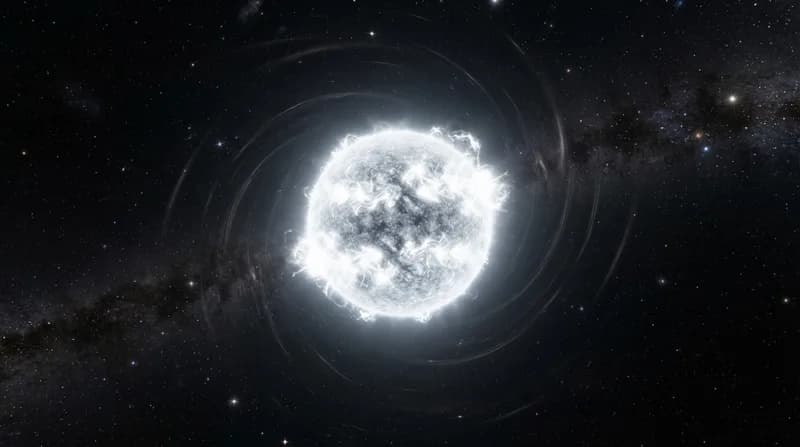
In a profound challenge to our current understanding of stellar mechanics, astronomers utilizing the European Southern Observatory’s (ESO) Very Large Telescope have uncovered a celestial anomaly. The object, a white dwarf star cataloged as RXJ0528+2838, is generating a powerful, persistent bow shock—a feature that, according to established astronomical models, simply should not exist in this specific context.
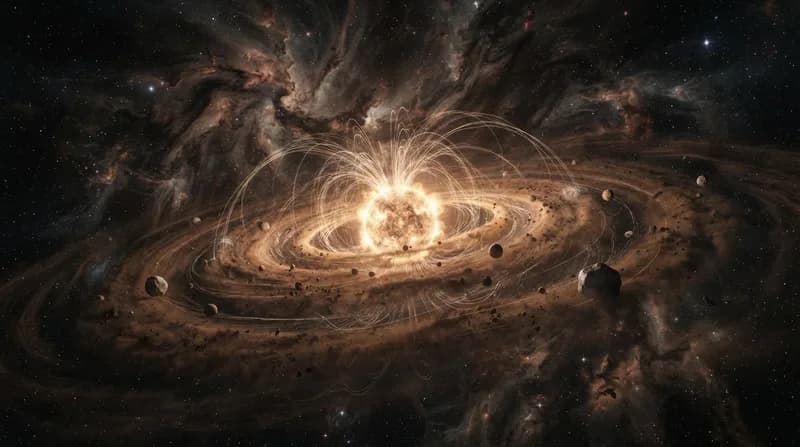
Typically, bow shocks occur when a star is moving through space and its own energetic outflows collide with interstellar gas and dust. This creates a curved arc of material similar to the wake trailing a moving vessel. However, for a white dwarf to produce such a structure, it generally requires a surrounding accretion disk—a dense ring of matter stolen from a companion star that fuels the outflow. RXJ0528+2838, which orbits a Sun-like companion, possesses no such disk, leaving researchers at a loss to explain the engine driving this 1,000-year-old cosmic phenomenon.
The Magnetic Enigma
The research team, which recently published their findings in Nature Astronomy, turned to the Multi-Unit Spectroscopic Explorer (MUSE) instrument on the VLT to conduct a high-resolution autopsy of the system. The data confirmed that the star possesses an exceptionally strong magnetic field. It appears that instead of the companion’s matter forming a stable disk, the star’s powerful magnetic pull acts as a funnel, directing material straight onto the white dwarf's surface.
While this magnetic channeling explains how the star interacts with its companion, it creates a secondary puzzle regarding energy. The energy required to sustain a bow shock of this magnitude for at least a millennium far exceeds what the star’s current magnetic field should be capable of producing. Scientists are now hypothesizing the existence of a 'mystery engine'—an unknown mechanism or energy source within the binary system that continues to power this massive outflow despite the absence of an accretion disk.
Why It Matters
This discovery forces a reassessment of how energy and matter move within binary star systems. Because these systems are fundamental to our understanding of stellar evolution, the 'mystery engine' identified here could be a missing link in high-energy astrophysics. The findings challenge the standard paradigm that white dwarfs are passive remnants, suggesting instead that they can exert far more influence on their surroundings than previously theorized.
Future Implications and the Search for Answers
The persistence of the shock wave, spanning at least 1,000 years, implies that this process is not merely a transient flicker but a long-term characteristic of the binary system. As the astronomical community looks toward the next generation of hardware, specifically the Extremely Large Telescope (ELT), there is hope that we can peer into more distant, fainter systems to determine if RXJ0528+2838 is a unique outlier or part of a previously overlooked class of active dead stars.
By cataloging similar systems and mapping their outflows with greater precision, researchers aim to isolate the variables that allow these 'discless' stars to defy conventional physics. Until then, the white dwarf RXJ0528+2838 remains a striking example of how much of our universe remains hidden, waiting for the right tools to bring its secrets into focus.