Rewriting the Solar Origin Story
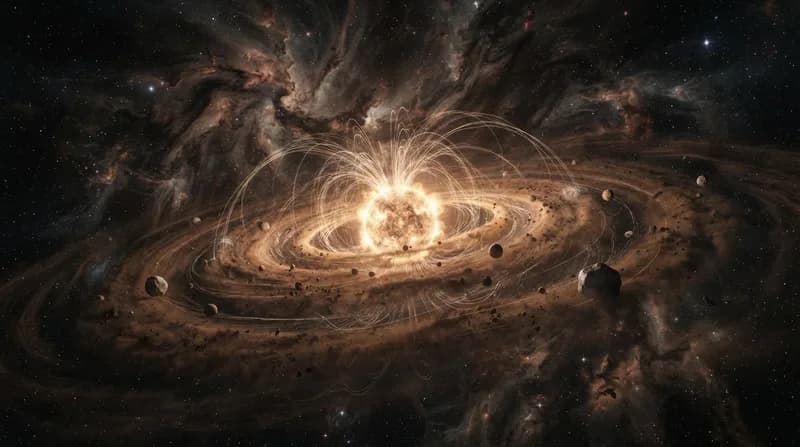
For decades, the standard narrative of our solar system’s birth has centered on gravity as the primary sculptor. The theory holds that a massive, swirling cloud of gas and dust—the solar nebula—collapsed under its own weight to form the sun and the protoplanetary disk. However, new research from the Massachusetts Institute of Technology (MIT) suggests this account is incomplete. By analyzing some of the oldest materials ever recovered, scientists have found evidence that a formidable, invisible hand was also at work: a powerful magnetic field.
The study, published in the Proceedings of the National Academy of Sciences, shifts our understanding of the early solar system by identifying that magnetism played a fundamental role during the very first 200,000 years of existence. This discovery suggests that as the nebula transitioned from a spherical cloud into a flattened disk, magnetic fields were already active, acting as a critical catalyst for the movement of primordial matter toward the developing star at the center.
The Time Capsule Within a Meteorite
The key to this breakthrough lies in a rare meteorite known as DOM 08006, discovered in the Dominion Range of Antarctica in 2008. While most space rocks have been heavily altered by water, heat, or geological activity over the last 4.5 billion years, DOM 08006 remains remarkably pristine. Its internal structure contains calcium-aluminum-rich inclusions (CAIs), which are effectively the oldest solids formed in the solar system.
By isolating these microscopic grains, the research team sought to find "remanent magnetization"—a permanent magnetic record captured by minerals as they cooled and condensed from the hot gases of the nascent solar nebula. Because these grains were present before the sun had fully finished forming, they serve as a unique, high-fidelity time capsule of the environment that existed before the planets were even conceived.
Key Findings and Implications
- Field Strength: Measurements indicate an early magnetic field between 150 and 600 microteslas, up to 12 times stronger than the magnetic field generated by Earth today.
- Mechanism of Formation: The presence of such a strong field suggests that charged particles moving through the solar nebula created a dynamic plasma that fueled the collapse of the disk.
- Redefining Gravity: While gravity provided the baseline for collapse, magnetism likely accelerated the migration of gas and dust toward the center, helping to concentrate the material necessary for stellar birth.
- Scientific Consensus: This study effectively ends the debate over whether magnetism was a player in the pre-planetary stage, confirming that it is an essential ingredient in any model of solar system formation.
An Outlook on Our Galactic Origins
The implications of this research extend far beyond our own neighborhood. By proving that magnetism is a foundational force in disk evolution, astronomers can now better model the birth of other planetary systems throughout the Milky Way. Understanding how magnetic fields influence the distribution of gas and dust allows scientists to predict how planetary materials—and potentially the building blocks of life—are concentrated during the chaotic early phases of stellar development.
This work, supported by NASA, highlights the importance of analyzing the most ancient, primitive meteorites in our possession. As MIT professor Benjamin Weiss and his team have demonstrated, the answers to our most fundamental cosmic questions are often hidden in the microscopic details of space debris that has survived the violence of billions of years. As we continue to gaze at distant stars and protoplanetary disks, we now have a much clearer, more magnetic picture of exactly how we got here.