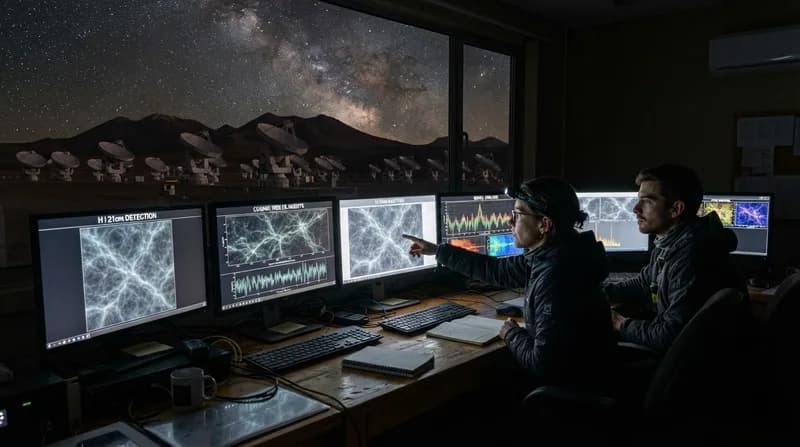
Mapping the Cosmic Web with Neutral Hydrogen
A team of international researchers, spearheaded by the University of Manchester and the University of the Western Cape, has achieved a significant milestone in observational cosmology. Using the MeerKAT radio telescope in South Africa, the team has successfully identified a faint radio emission originating from neutral hydrogen gas located billions of light-years away. This achievement marks a transition from traditional galaxy-by-galaxy identification to a more sophisticated technique known as hydrogen intensity mapping.
The methodology relies on detecting the 21-centimeter line, a natural radio emission signature of neutral hydrogen. As the universe expands, these signals stretch into longer wavelengths, effectively acting as a cosmic timestamp. By measuring the combined glow from vast collections of galaxies rather than attempting to isolate individual entities, astronomers can effectively capture a broader, more cohesive snapshot of the distribution of matter across the history of the cosmos.
The Technical Challenge of Faint Signals
Extracting this data required the processing of approximately 96 hours of observations recorded by the MeerKAT telescope, some of which dated back to the facility's early operational period in 2018. The signal, which traveled between four and five billion years to reach our solar system, presented immense analytical challenges. The research team had to meticulously filter out terrestrial radio interference, atmospheric noise, and other foreground cosmic signals that typically mask such delicate measurements.
This breakthrough is particularly notable for its reliance solely on radio telescope data. Previously, similar mappings necessitated the cross-referencing of radio observations with optical galaxy surveys. By demonstrating that MeerKAT can isolate these signals independently, the researchers have validated a scalable, efficient pipeline for future large-scale cosmological surveys. This capability allows for the analysis of cosmic volumes comparable to the spatial separation between the Milky Way and the Andromeda galaxy, offering a new perspective on how matter is structured across intergalactic distances.
Why It Matters
- Efficiency: Intensity mapping bypasses the need to identify every individual galaxy, allowing for faster and larger-scale surveys of the universe.
- Evolutionary Insight: This method provides a clear view into how galaxies formed and shifted throughout billions of years of cosmic history.
- Technological Foundation: The success serves as a critical proof-of-concept for the upcoming Square Kilometre Array Observatory (SKAO), for which MeerKAT acts as a vital precursor.
- Cosmic Structure: Improved precision in mapping neutral hydrogen helps clarify the role of dark matter in shaping the cosmic web.
An Outlook on Future Cosmic Surveys
The successful extraction of this signal from pre-existing data suggests that archival records from MeerKAT hold immense untapped scientific potential. As researchers refine the algorithms used to isolate these faint emissions, the ability to reconstruct the three-dimensional distribution of matter will only improve. This evolution in observational strategy is essential for the next generation of telescopes, which aim to map the sky with unprecedented depth and resolution.
Looking ahead, the integration of these findings into larger datasets will enable scientists to better understand the developmental timeline of galaxies. By tracing the distribution of hydrogen across cosmic epochs, astronomers are essentially drafting a more comprehensive blueprint of the universe. This provides a clearer understanding of the forces that drove galaxy formation and the persistent influence of dark matter, setting the stage for a new era of high-precision cosmology.