ScienceTechnical Deep Dive

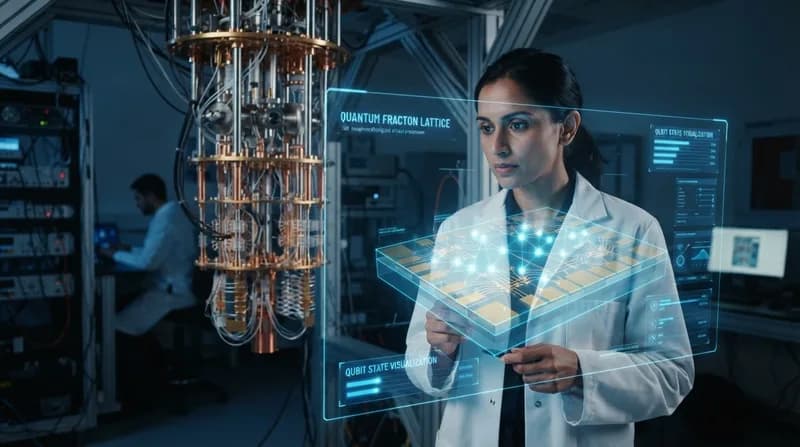
Closing in on the Invisible: Researchers Discover Pathway to Detecting Quantum Fractons

Published
EElectricBuzz Editorial Team
Closing in on the Invisible: Researchers Discover Pathway to Detecting Quantum Fractons
3 min read508 wordsElectricBuzz Editorial Team

The Gist

Physicists have developed a more realistic quantum model that suggests fractons—elusive, immobile quasiparticles—could be the key to ultra-stable quantum information storage.

The Quest for Stationary Quantum Particles

In the complex world of quantum solid-state physics, researchers are constantly hunting for exotic phenomena that defy classical expectations. Recently, a team at the Helmholtz-Zentrum Berlin (HZB) achieved a significant milestone in the theoretical study of fractons—quasiparticles that have long remained purely speculative. Unlike electrons or phonons that zip through materials with relative ease, fractons are defined by their profound immobility, a trait that makes them highly alluring for future quantum computing architectures.

Quasiparticles are essentially emergent entities born from the collective behavior of thousands of interacting particles. While scientists have understood the existence of particles like phonons—vibrations in a crystal lattice—for decades, fractons occupy a strange, constrained niche. They appear at the boundaries of magnetic domains and possess a unique property: they are essentially trapped in place, unable to move unless they interact with other fractons. This inherent "stickiness" provides a potential solution to one of the biggest hurdles in quantum computing: the fragility of quantum information.

Bridging the Gap Between Theory and Reality

Historically, fractons were predicted using generalized gauge field theories that were mathematically elegant but physically abstract. Previous attempts to simulate them in realistic quantum systems frequently hit a wall: the fractons would either vanish entirely when quantum effects were heightened or lose their quantum identity when conditions were simplified, effectively behaving like classical particles. This left researchers in a bind, unable to confirm whether these particles could exist in genuine quantum materials.

By refining their numerical simulations and improving how they represent spin interactions, the HZB team, led by Professor Johannes Reuther and Dr. Nils Niggemann, successfully demonstrated that fractons can emerge under realistic quantum conditions. This breakthrough confirms that the previously theorized states of matter—specifically in quantum spin liquids where magnetic moments continue to fluctuate even at absolute zero—could actually host these immobile excitations. By proving their existence in a realistic model, the team has provided a clear roadmap for experimentalists to finally hunt for these particles in a lab setting.

Why It Matters: The Path to Stable Quantum Storage

  • Enhanced Stability: Because fractons are nearly immobile, they are less prone to the environmental noise that typically causes quantum information (qubits) to collapse or "decouple."
  • Robust Memory: Their restricted movement makes them ideal candidates for building memory storage that is naturally resistant to errors.
  • New Experimental Frontiers: The researchers suggest that Rydberg atom simulators could provide the ideal controlled environment to observe these particles in action, moving the field from computer models to empirical verification.

The Road Ahead: Experimental Verification

The successful simulation is only the beginning. The next major hurdle is identifying or synthesizing real-world physical systems that mimic the specific conditions outlined in the new HZB model. Collaboration between theorists and experimental solid-state physicists is currently the primary engine driving this progress. By leveraging platforms like Rydberg atom simulators, the scientific community may soon move past theoretical modeling and into an era where fractons are observed, manipulated, and eventually utilized as the building blocks for a more robust and fault-tolerant generation of quantum hardware.

The 5 Best Over-Ear ANC Headphones of 2026, Tested & Ranked
Editor's Pick Guide
92/100
Tech & Gadgets12 min read

The 5 Best Over-Ear ANC Headphones of 2026, Tested & Ranked

We locked five over-ear ANC picks for 2026 — Sony WH-1000XM6, Bose QuietComfort Ultra 2, Soundcore Space One, Sennheiser Momentum 5, and Apple AirPods Max 2 — then stress-tested them on lab metrics, long-term owner truth, and live street prices.

Related Stories

Semantically matched articles, ranked by topic overlap and freshness.

NASA's Roman Space Telescope Set for Two Decades of Cosmic Discovery
Science

NASA's Roman Space Telescope Set for Two Decades of Cosmic Discovery

Thanks to exceptional launch precision and significant fuel savings, the Nancy Grace Roman Space Telescope is poised to more than double its mission life, potentially operating for over 22 years.

Unlocking Predictive Markers: How B Cells Could Forecast Immunotherapy-Induced Colitis
Science

Unlocking Predictive Markers: How B Cells Could Forecast Immunotherapy-Induced Colitis

New research from MD Anderson Cancer Center suggests that B cell activity acts as a crucial early-warning system for identifying patients at risk of developing severe colitis during cancer treatment.

Could a Tiny Brain Protein Be the Master Switch for Aging?
Science

Could a Tiny Brain Protein Be the Master Switch for Aging?

Researchers have identified that declining levels of a brain protein called Menin may drive systemic aging, offering a potential new target for age-related health interventions.

Challenging Einstein: Scientists Pioneer Gravity Tests Using Exotic Muonium Atoms
Science

Challenging Einstein: Scientists Pioneer Gravity Tests Using Exotic Muonium Atoms

Researchers at ETH Zurich have developed a method to create controlled beams of muonium, potentially enabling the first-ever gravitational tests on second-generation particles.

Unlocking the Narrative: AI System Transforms Physician Notes into Actionable Medical Data
Science

Unlocking the Narrative: AI System Transforms Physician Notes into Actionable Medical Data

A groundbreaking study reveals how a new AI system can parse clinical prose at scale, converting hidden patient insights into verifiable, computer-readable data.

Caltech’s Femtosecond Breakthrough: Steering Light with Light
Science

Caltech’s Femtosecond Breakthrough: Steering Light with Light

Researchers have engineered a nanoscale silicon metasurface capable of redirecting light beams in just 74 quadrillionths of a second, shattering traditional speed barriers in photonic computing.

Beyond the Starch: Why Black and Green Rice Are Emerging as Metabolic Superfoods
Science

Beyond the Starch: Why Black and Green Rice Are Emerging as Metabolic Superfoods

New research from Hokkaido University reveals that pigmented rice varieties contain unique, beneficial fats that could revolutionize dietary approaches to blood sugar management.

Biological Breakthrough: Scientists 3D-Print a Functional Human Gut-on-a-Chip
Science

Biological Breakthrough: Scientists 3D-Print a Functional Human Gut-on-a-Chip

Researchers at Lawrence Livermore National Laboratory have successfully replicated the complex 3D architecture of the human small intestine on a compact, microfluidic device.