A New Forensic Lens for Battery Health
Understanding exactly why and how lithium-ion batteries degrade has long been a 'black box' challenge for the EV industry. While we can easily measure a decrease in total capacity, identifying the specific, competing chemical processes responsible for that loss is notoriously difficult. Now, a research team at the Federal Institute for Materials Research and Testing (BAM) has cracked a new code: they are using the natural isotopes of lithium as a built-in, forensic diagnostic tool.
By analyzing the ratio of lithium-6 to lithium-7 isotopes within a cell, scientists have identified a 'fingerprint' that reveals exactly how a battery is aging. This discovery, detailed in the journal ACS Energy Letters, provides a precise, layer-by-layer map of degradation that could revolutionize how we design, maintain, and recycle electric vehicle batteries.
The Science of Isotopes as Markers
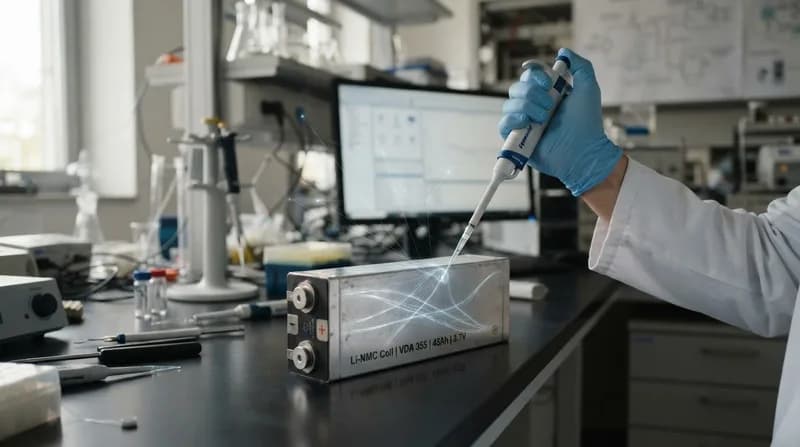
Natural lithium is composed of two isotopes: lithium-6 and the heavier lithium-7, which exist in a standard ratio of 2.4% to 97.6% in a pristine cell. However, as a battery undergoes charge and discharge cycles, these isotopes begin to behave differently. BAM researchers, in collaboration with Nu Instruments Ltd. and IFW Dresden, utilized high-resolution mass spectrometry to observe how these isotopes migrate during the lifespan of a lithium-nickel-manganese-cobalt (NMC) battery.
The study revealed that lithium-6 shows a distinct preference for accumulating at the anode during early charge cycles. As the cycle count grows, this separation becomes more pronounced, with the cathode showing a marked increase in lithium-7 concentration. Because this shift correlates directly with measured capacity loss, the isotopes essentially act as natural, built-in markers that track the internal health of the battery in real-time.
Why It Matters
- Early Detection: Current methods typically signal failure after it happens. Isotope analysis could identify degradation patterns long before significant capacity loss occurs.
- Targeted Engineering: By knowing exactly which chemical mechanism is triggering a specific failure, manufacturers can adjust cathode or anode chemistry to eliminate those weak points.
- Second-Life Potential: As the market for used EV batteries grows, this forensic tool could help determine the remaining useful life (RUL) of a cell with unprecedented accuracy, making repurposing for grid storage much safer and more reliable.
Future Implications for Battery Design
The ability to pinpoint the 'why' behind battery wear is a massive step forward for the mobility sector. Rather than relying on guesswork or generic algorithmic estimates, engineers can now use this high-resolution data to stress-test new materials against specific aging patterns. This move toward 'diagnostic forensics' promises to extend the service life of future EV packs while paving the way for more durable, high-density cell architectures.
While this technique currently requires sophisticated lab equipment like mass spectrometers, the research paves the way for a new generation of diagnostic protocols. As the industry strives to optimize battery longevity to lower total cost of ownership, the 'lithium fingerprint' is set to become a foundational component of battery research and development.