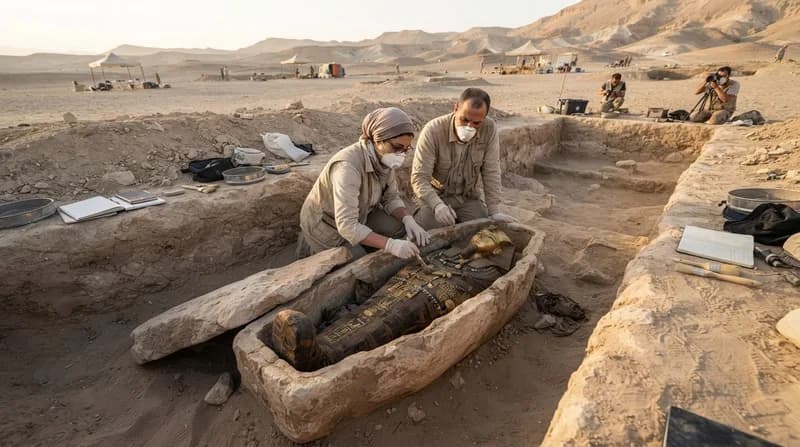
A New Discovery in the Theban Necropolis
In a significant archaeological find, a research team working in the Lower Sheikh Abd el-Qurna area of the Theban necropolis has unearthed a 3,000-year-old tomb. The discovery was made during a critical conservation effort intended to protect historical sites from the increasing threat of flash floods. As the team systematically removed debris to divert water away from the ancient hillside structures, they encountered the entrance to a burial site that had remained hidden for millennia.
The tomb, dating back to the Ramesside period (approximately 1292–1069 BC), serves as a time capsule from an era when Thebes—modern-day Luxor—stood as the political and religious heartbeat of Egypt. Preliminary analysis of the site reveals a standard elite layout for the period, featuring an outer courtyard, a rock-cut chapel, and subterranean chambers. A mudbrick platform and a unique staircase with side ramps indicate that the site was constructed with both accessibility and religious ceremony in mind.
Vivid Insights into Daily Life
The interior of the rock-cut chapel has provided researchers with exceptionally preserved wall paintings. These artworks depict the tomb's owner, identified as an official named Paser, performing various religious duties and engaging with deities. Perhaps most striking are the scenes showing Paser and his wife gathered before an offering table piled with an array of ritual gifts, including bread, beer, meat, fruits, and flowers. These murals serve as more than just decoration; they offer a window into the societal hierarchy and the domestic culture of the Ramesside elite.
Currently, the paintings are obscured by a layer of accumulated sediment and dirt. Conservation experts are preparing to meticulously clean the walls, a process expected to reveal more specific details regarding the family history and the identities of other individuals potentially interred within the complex. Scientists hope that further study of the tomb will answer long-standing questions regarding why officials chose to reuse or build alongside the monuments of the 18th-dynasty elite, shedding light on the evolving landscape of ancient funerary practices.
The Critical Need for Preventive Conservation
The discovery underscores the fragile state of the region's archaeology. Climate change has led to more frequent and intense flash flooding in the area, which poses a severe risk to the integrity of these ancient monuments. Moisture-driven damage, such as the crystallization of salts and the potential for total structural failure, remains a constant danger. The ongoing project is, therefore, as much an act of preservation as it is a scientific excavation.
Why it Matters
- Preservation: The project demonstrates the necessity of integrating modern disaster management with historical research to prevent the irreversible loss of ancient heritage.
- Historical Insight: Unlike the well-documented Valley of the Kings, the Lower Sheikh Abd el-Qurna site has been largely under-studied, offering a fresh perspective on the lives of middle-to-upper-tier officials.
- Methodology: The use of non-invasive, debris-clearing techniques serves as a model for how future archaeological work can be conducted safely within environmentally sensitive areas.
As the international research team continues its collaboration with the Egyptian Ministry of Tourism and Antiquities, the focus remains on stabilizing the area. By securing these monuments against nature's forces, the project is ensuring that the historical treasures of Lower Sheikh Abd el-Qurna can finally be cataloged, understood, and shared with the world.