E-BUZZ ME Logo
ScienceTechnical Deep Dive

Wearable Ultrasound Pacemaker Offers Non-Invasive Heart Rhythm Control

Published
Wearable Ultrasound Pacemaker Offers Non-Invasive Heart Rhythm Control
1 min read151 words

The Gist

A breakthrough wearable device utilizes sonogenetics and ultrasound technology to manage cardiac rhythm disorders without the need for invasive surgery.

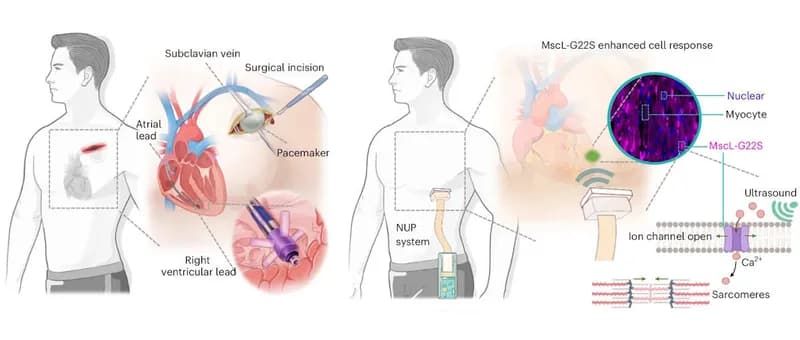
Researchers have developed a pioneering wearable pacemaker that leverages ultrasound technology to regulate heart rhythms non-invasively. By integrating the field of sonogenetics with precise ultrasound delivery, the device aims to provide a painless alternative to traditional, surgically implanted pacemakers.

How Sonogenetics Works

The technology functions by using ultrasound waves to trigger specific biological responses within cardiac tissue. This method, known as sonogenetics, allows for the external modulation of heart cells, effectively managing rhythm disorders without the risks associated with lead placement or battery replacement surgeries.

A New Era for Cardiac Care

While still in the developmental stages, this wearable solution represents a significant shift in cardiology. It offers the potential for temporary pacing in emergency situations or long-term management for patients who are not ideal candidates for invasive procedures. The integration of wearable sensors with ultrasound emitters ensures that the device can monitor and respond to heart rate fluctuations in real-time.

Related Stories

Semantically matched articles, ranked by topic overlap and freshness.

GPS Satellite Network Provides Two Decades of Space Radiation Data
Science71%

GPS Satellite Network Provides Two Decades of Space Radiation Data

A massive cross-calibration effort involving 25 GPS satellites has unlocked twenty years of continuous space radiation tracking.

New Class of Magnons Exhibits Hundred-Fold Increase in Lifespan
Science70%

New Class of Magnons Exhibits Hundred-Fold Increase in Lifespan

A breakthrough discovery of long-lived magnons could pave the way for scalable, nanoscale quantum information technologies on-chip.

The Physics Behind the Snap: Understanding the Venus Flytrap
Science70%

The Physics Behind the Snap: Understanding the Venus Flytrap

New research delves into the complex physics that allows the Venus flytrap to snap shut with incredible speed to capture its prey.

John Bell and the Legacy of the Journal 'Physics'
Science66%

John Bell and the Legacy of the Journal 'Physics'

A look back at the short-lived journal where John Bell published his ground-breaking theorem, forever changing our understanding of quantum mechanics.

The Future of Open Access: Navigating Structural Challenges and AI Integration
Science66%

The Future of Open Access: Navigating Structural Challenges and AI Integration

As the scientific community pushes for an open-access future, experts warn that systemic issues and the rise of AI must be addressed to ensure sustainability.

Self-Repairing Bio-Textiles: Scientists Create Clothing From Living Fungi
Science61%

Self-Repairing Bio-Textiles: Scientists Create Clothing From Living Fungi

Researchers have developed a revolutionary biodegradable textile using the parasitic fungus Cordyceps militaris that can clean and repair itself.

Sweden Explores Rare Earth Deposits to Challenge Global Supply Dominance
Science60%

Sweden Explores Rare Earth Deposits to Challenge Global Supply Dominance

Researchers are mapping Sweden's mineral wealth to create magnets from natural element combinations, aiming to reduce reliance on Chinese exports.

AI Aids Stanford Researchers in Discovering Natural Weight Loss Molecule
Science60%

AI Aids Stanford Researchers in Discovering Natural Weight Loss Molecule

Stanford scientists have identified a natural molecule that mimics the weight-loss effects of Ozempic with fewer side effects by targeting specific brain regions.