1. The Volvo FH Aero Electric
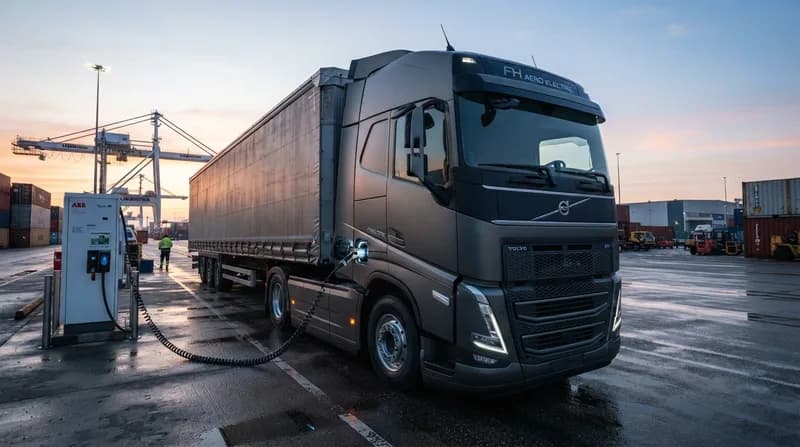
Volvo Trucks has officially moved from prototype phase to industrial reality by commencing series production of the highly anticipated FH Aero Electric. Manufactured at the company’s flagship plant in Tuve, Sweden, this long-haul specialist represents a major shift in the logistics industry. The truck is defined by its substantial battery architecture, housing eight battery packs that provide a total installed capacity of 780 kWh, with 725 kWh of that energy usable for propulsion. This robust power density is the secret behind its industry-leading 700-kilometer range on a single charge.
Beyond the raw battery specs, the FH Aero Electric incorporates a new e-axle designed to maximize efficiency across diverse transport applications. The vehicle is engineered to provide superior drivability compared to its diesel counterparts while offering the flexibility required for modern supply chains. With order books already filling up, Volvo is positioning this model as the primary catalyst for the widespread electrification of long-haul European transport, aiming to bridge the gap between heavy-duty requirements and zero-emission goals.
2. The New 80-Tonne Electric Heavy-Hauler
Stepping well beyond standard shipping weights, Volvo Trucks also unveiled a gargantuan electric truck capable of handling gross combination weights (GCW) of up to 80 tonnes. This specialized vehicle is engineered for heavy-duty logistics tasks that far exceed the typical 42-tonne limit found in many European markets. Due to the unique regulatory landscapes required for such heavy transport, Volvo is initially targeting specific markets, including Sweden, Norway, Finland, Denmark, the Netherlands, and Switzerland, where higher weight limits are permitted.
The performance metrics for this behemoth are impressive for its size class. When operating at a gross combination weight of 64 tonnes, the truck achieves an operational range of up to 450 kilometers per charge. For the even heavier 74-to-76-tonne configurations common in Nordic regions like Sweden and Finland, the range remains a functional 420 kilometers. The truck utilizes a fixed-body design paired with a trailer, providing a modular solution for high-capacity freight. Volvo plans a phased market rollout for these heavy-haulers beginning in early 2027, with the vehicle compatible with almost all FH cab configurations, excluding the XXL variant.
Why It Matters
- Decarbonizing Heavy Freight: By enabling 80-tonne loads to move without internal combustion, Volvo is addressing one of the most difficult segments of the transport sector to electrify.
- Battery Efficiency: The FH Aero Electric's use of 725 kWh of usable capacity sets a new standard, forcing competitors to rethink their battery-to-weight ratios.
- Operational Economics: Higher load capacities in electric transport significantly reduce the per-unit carbon footprint, making sustainable logistics more economically viable for large shipping fleets.