E-BUZZ ME Logo
ScienceTechnical Deep Dive

Vera C. Rubin Observatory Begins Ambitious 10-Year Cosmic Mapping Mission

Published
Vera C. Rubin Observatory Begins Ambitious 10-Year Cosmic Mapping Mission
1 min read175 words

The Gist

The Legacy Survey of Space and Time is set to revolutionize our understanding of the universe by capturing the southern night sky every few nights.

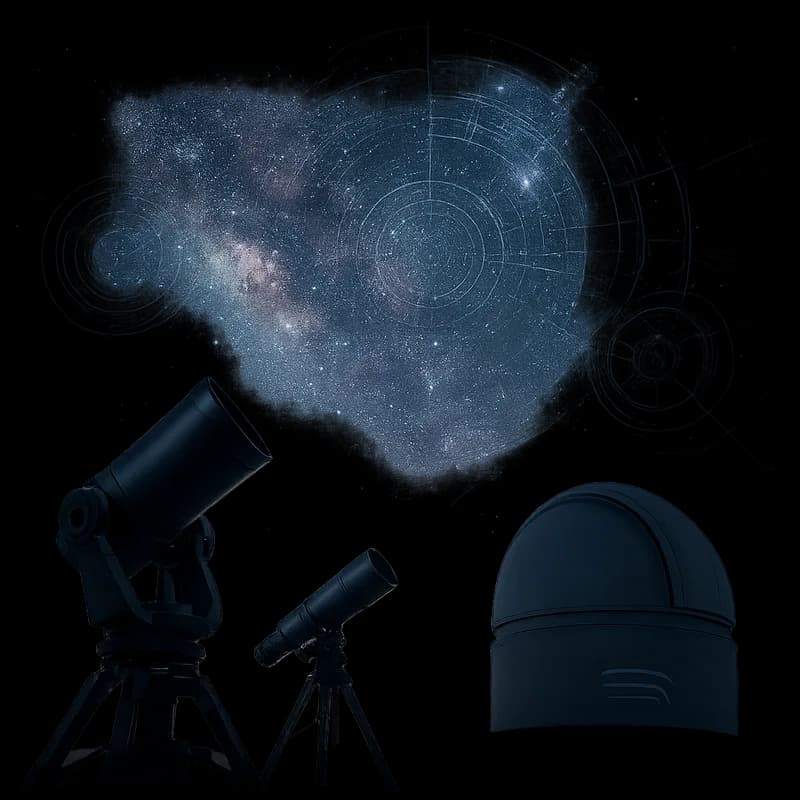
The scientific community has officially marked the start of a monumental decade-long project at the Vera C. Rubin Observatory. The facility is embarking on the Legacy Survey of Space and Time (LSST), a mission designed to provide the most comprehensive map of the cosmos ever created.

A Dynamic View of the Universe

Unlike traditional surveys that capture static images of the sky, the LSST will operate with unprecedented frequency. The observatory is scheduled to take high-resolution pictures of the entire visible southern night sky every 3 to 4 nights. This rapid cadence will allow astronomers to track changes in the universe in near real-time, from moving asteroids to distant supernovae.

Over the next ten years, the data gathered by the Vera C. Rubin Observatory is expected to provide critical insights into dark matter, dark energy, and the structural evolution of our galaxy. By the end of the mission, the survey will have produced a vast catalog of celestial objects, offering a deep and temporal perspective on the night sky that was previously impossible to achieve.
Related Stories

Semantically matched articles, ranked by topic overlap and freshness.

Quarks and Qubits: The Quantum Computing Revolution in Particle Physics
Science70%

Quarks and Qubits: The Quantum Computing Revolution in Particle Physics

New research explores how the intersection of quantum information and general relativity could redefine our understanding of subatomic particles.

The Future of Medical Imaging: Insights from Simon R. Cherry
Science69%

The Future of Medical Imaging: Insights from Simon R. Cherry

Former PMB editor-in-chief Simon R. Cherry discusses the evolving landscape of molecular imaging and non-invasive technologies in medical physics.

Unlocking New Conductivity Pathways in Mott Insulators
Science67%

Unlocking New Conductivity Pathways in Mott Insulators

Recent research into laser-driven feedback effects in Mott insulators reveals groundbreaking methods for engineering conductivity in strongly interacting systems.

NASA’s Webb Telescope Uncovers Hidden Giant Planet in Beta Pictoris System
Science64%

NASA’s Webb Telescope Uncovers Hidden Giant Planet in Beta Pictoris System

Astronomers have discovered a hidden giant planet, Beta Pictoris d, using the James Webb Space Telescope to peer through a dense disk of cosmic dust.

New Study Challenges the Existence of Dark Energy
Science64%

New Study Challenges the Existence of Dark Energy

A controversial research paper suggests that the universe’s expansion may not be accelerating, potentially eliminating the need for dark energy as a scientific explanation.

Fields Medal 2026: Mathematicians Honored for Unifying Physics Laws
Science63%

Fields Medal 2026: Mathematicians Honored for Unifying Physics Laws

The prestigious Fields Medal has been awarded to mathematicians whose groundbreaking work bridges the gap between geometry and the fundamental laws of physics.

Anish Kapoor’s Hayward Gallery Exhibition Explores the Science of Perception
Science63%

Anish Kapoor’s Hayward Gallery Exhibition Explores the Science of Perception

A new exhibition by Anish Kapoor at the Hayward Gallery uses light-absorbing Vantablack and visceral forms to challenge our understanding of reality and science.

NASA to Conduct Orbital Rehearsals with SpaceX and Blue Origin Landers
Science63%

NASA to Conduct Orbital Rehearsals with SpaceX and Blue Origin Landers

NASA astronauts will perform critical docking tests with prototype lunar landers from SpaceX and Blue Origin during the Artemis III mission in 2027.