A Glimpse Into the Lower Cretaceous
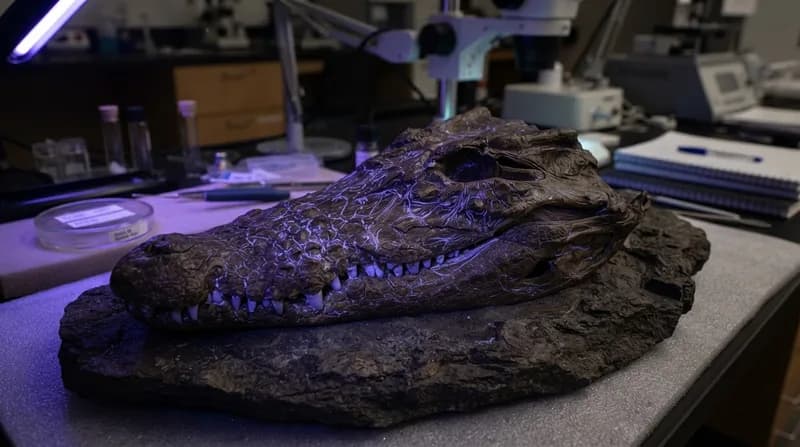
A breakthrough in paleontological imaging has provided an unprecedented look at the life of a small, ancient relative of the modern crocodile. The fossil, cataloged as MGB-512 and identified as Montsecosuchus depereti, was discovered over a century ago in the lithographic limestones of Pedrera de Meià in Spain. While the specimen has been known to the scientific community for decades, it took modern ultraviolet (UV) light technology for researchers at the Institut Català de Paleontologia Miquel Crusafont to unveil details that had remained obscured in the rock for 125 million years.
By utilizing UV light to differentiate between fossilized soft tissue and the surrounding limestone matrix, the research team successfully mapped out a treasure trove of biological data. The specimen, which measures roughly 50 centimeters in length, dates back to a period when this crocodylomorph inhabited karstic lake environments near the coast. The exceptional preservation conditions of the site, a Konservat-Lagerstätte, allowed for the survival of delicate anatomical structures that are typically lost to decomposition.
Revealing Skin and Sensory Evolution
The UV analysis provided the first detailed characterization of the organism's dermal anatomy. Researchers identified a diverse array of epidermal scales varying in shape and size across the creature's frame. Notably, the fossil reveals that Montsecosuchus depereti lacked the prominent caudal fins found on its modern descendants, suggesting a unique evolution in aquatic locomotion for this specific lineage.
Perhaps more significantly, the study uncovered potential evidence of sensory organs embedded within the scales along the animal's neck, limbs, and trunk. In modern crocodiles, similar sensory structures are vital for detecting touch, water pressure fluctuations, temperature shifts, and chemical cues. The localization of these potential sensors in Montsecosuchus suggests an early evolutionary pathway, implying that these specialized sensory systems may have originated in localized skin areas before becoming the widespread, integrated features seen in today’s crocodilians.
Respiratory Sophistication and Ancient Camouflage
Beyond external features, the UV imaging exposed cartilaginous structures within the chest cavity, pointing to a surprisingly advanced respiratory system. This thoracic anatomy indicates that even at this primitive stage of evolutionary development, the species was already highly adapted for a semi-aquatic lifestyle, possessing internal mechanics similar in sophistication to those of modern relatives.
The most compelling discovery, however, lies in the animal's tail. UV light revealed alternating light and dark bands across the caudal scales, which researchers interpret as potential evidence of original skin coloration. This pattern bears the hallmarks of disruptive camouflage, a common biological strategy used to break up an animal's outline against its surroundings to evade predators or ambush prey. If verified, this discovery would represent the oldest known instance of color pattern preservation in a crocodylomorph, marking a significant milestone in our understanding of vertebrate evolution and the early development of defensive traits in the reptilian lineage.
Why it Matters
- Technological Leap: The use of UV light imaging proves that even century-old fossil collections contain untapped biological data waiting for modern analytical tools.
- Evolutionary Timeline: The presence of advanced respiratory systems and sensory organs 125 million years ago refines our timeline for when crocodylomorphs perfected their semi-aquatic survival traits.
- Coloration Insight: Identifying potential camouflage in such an ancient specimen challenges previous assumptions about the visual appearance of Early Cretaceous reptiles and opens new doors for paleo-coloration studies.