A New Frontier in Optical Computing
In the escalating arms race against synthetic media, researchers at UCLA have unveiled a groundbreaking approach that shifts the burden of detection from traditional digital processors to the physical properties of light. Led by Professor Aydogan Ozcan, the team has successfully developed an optical-neural processor capable of identifying deepfake videos with nearly 98% accuracy. By leveraging light diffraction, this system sidesteps the massive energy consumption and latency issues that have long plagued conventional, software-reliant detection models.
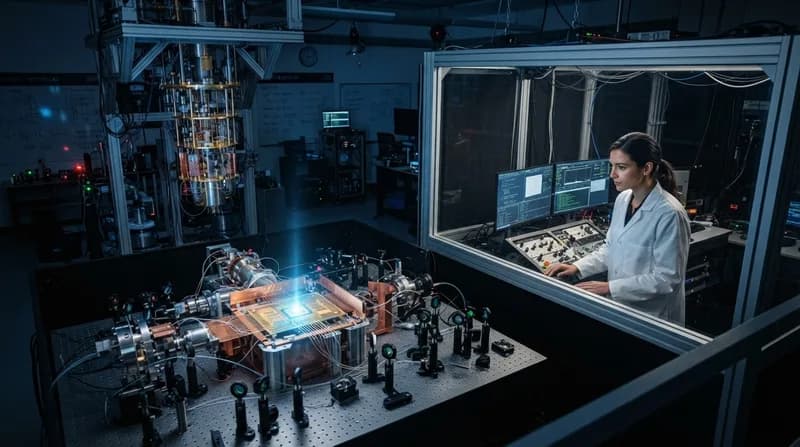
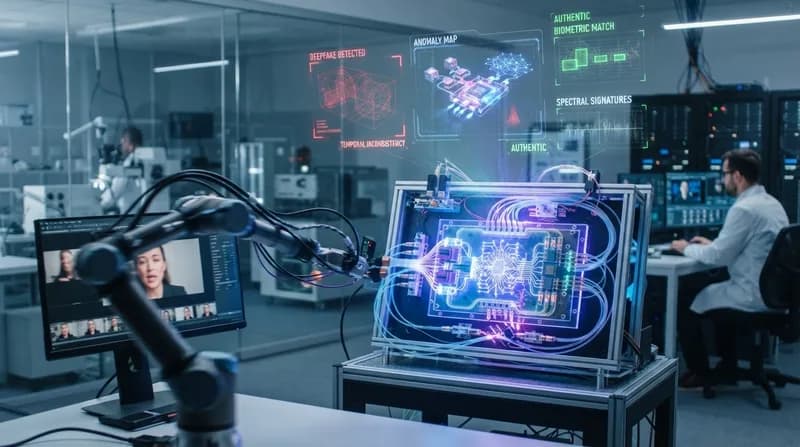
The architecture functions as a hybrid system. First, a lightweight digital encoder captures the essential spatial, spectral, and temporal characteristics of a video stream, converting them into a phase pattern. This pattern is then projected onto a spatial light modulator, where it travels through a passive optical decoder. Because this final decoding step relies on the physical propagation of light rather than power-hungry transistor-based computations, the system can process multiple video streams simultaneously, marking a significant departure from the sequential processing bottlenecks found in modern data centers.
Parallel Processing and High-Performance Metrics
The efficiency of the UCLA system is perhaps its most compelling feature. In recent testing, the processor demonstrated the ability to analyze 15 video streams concurrently in a single optical pass. This multiplexing capability allowed the system to achieve an average detection accuracy of 97.79%. Perhaps more impressive is its sensitivity rating of 99.86%, which essentially means that the tool rarely misses a manipulated file, boasting a false-negative rate of just 0.14%.
Even when pushed to handle 18 streams simultaneously, the system maintained an accuracy of over 96%. The researchers also integrated additional passive diffractive layers into the hardware design. These static optical surfaces perform complex calculations through the simple diffraction of light, requiring no additional electricity to function. This design choice effectively allows the processor to scale its performance and handle more sophisticated deepfake manipulations without suffering the exponential energy cost increases common in digital neural networks.
Why It Matters: Security and Scalability
As generative models like Google’s VEO-3 continue to produce increasingly realistic footage, the volume of content requiring verification has reached a breaking point for existing digital infrastructure. The UCLA team tested their optical processor against these newer, harder-to-detect fakes, and it remained highly effective, achieving nearly 95% accuracy with minimal fine-tuning. This adaptability is crucial for keeping pace with the rapid evolution of generative AI.
- Energy Efficiency: By offloading decoding to passive optical layers, the system slashes electricity requirements compared to traditional GPU-heavy detection.
- Parallel Throughput: Analyzing over a dozen videos at once enables high-speed screening for large-scale content moderation and media authentication platforms.
- Adversarial Resilience: The physical, hardware-embedded nature of the optical model makes it significantly harder for bad actors to reverse-engineer or spoof the system with traditional digital adversarial attacks.
- Robustness: The system maintains integrity even when faced with common video degradation issues, including blurring, JPEG compression, and digital noise.
Future Outlook
Rather than positioning this optical processor as a standalone replacement for all digital tools, the UCLA team suggests it will function best as a high-throughput, initial layer of defense. In this framework, massive volumes of incoming video are filtered through the optical processor, which quickly flags suspicious clips. Only these high-risk files would then be forwarded to more power-intensive digital models for a forensic-level assessment. This layered, tiered approach promises to modernize the pipeline for content moderation, surveillance, and security, creating a future where synthetic media can be vetted at the speed of light.