E-BUZZ ME Logo
ScienceTechnical Deep Dive

The Lasting Legacy of Erwin Schrödinger’s 'What Is Life?'

Published
The Lasting Legacy of Erwin Schrödinger’s 'What Is Life?'
1 min read188 words

The Gist

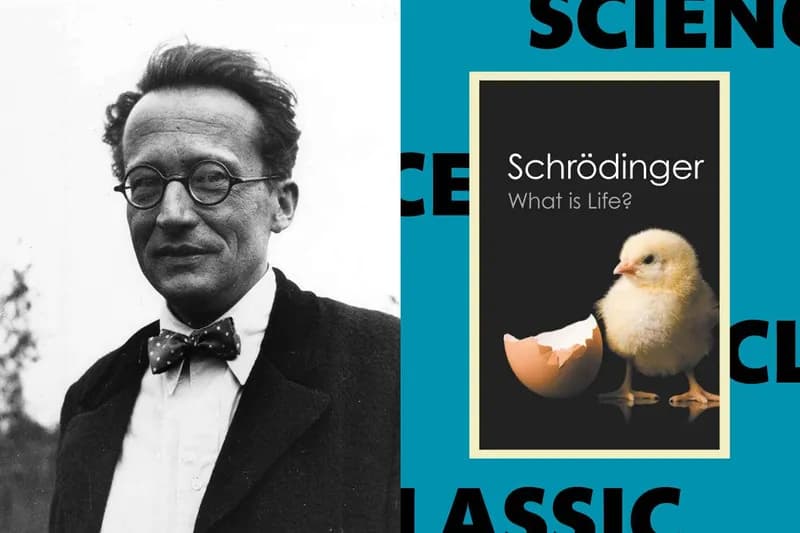
Decades after its publication, Erwin Schrödinger’s 1944 classic continues to bridge the gap between quantum physics and biological complexity.

In 1944, Erwin Schrödinger, a titan of quantum mechanics, pivoted from the world of subatomic particles to the fundamental questions of biology in his seminal work, 'What Is Life?'. Despite being over eighty years old, the text remains a cornerstone of popular science, praised for its visionary approach to how physical laws govern living organisms.

A Bridge Between Disciplines

Schrödinger’s exploration was revolutionary for its time, suggesting that life could be understood through the lens of physics and chemistry. He famously proposed the idea of an "aperiodic crystal" that could carry genetic information—a concept that predated the discovery of the DNA double helix structure by nearly a decade. This theoretical framework provided a roadmap for future molecular biologists to seek out the physical mechanisms of heredity.

Relevance in the Modern Era

As Karmela Padavic-Callaghan notes, the book’s influence persists because it challenges scientists to think across traditional boundaries. While some of Schrödinger’s specific biological assumptions have been updated by modern genomics, his central thesis—that life defies the simple entropy of the inorganic world through complex physical organization—remains a profound point of discussion in theoretical biology and biophysics today.
Related Stories

Semantically matched articles, ranked by topic overlap and freshness.

Quarks and Qubits: The Quantum Computing Revolution in Particle Physics
Science66%

Quarks and Qubits: The Quantum Computing Revolution in Particle Physics

New research explores how the intersection of quantum information and general relativity could redefine our understanding of subatomic particles.

Anish Kapoor’s Hayward Gallery Exhibition Explores the Science of Perception
Science64%

Anish Kapoor’s Hayward Gallery Exhibition Explores the Science of Perception

A new exhibition by Anish Kapoor at the Hayward Gallery uses light-absorbing Vantablack and visceral forms to challenge our understanding of reality and science.

The Future of Medical Imaging: Insights from Simon R. Cherry
Science63%

The Future of Medical Imaging: Insights from Simon R. Cherry

Former PMB editor-in-chief Simon R. Cherry discusses the evolving landscape of molecular imaging and non-invasive technologies in medical physics.

Unlocking New Conductivity Pathways in Mott Insulators
Science62%

Unlocking New Conductivity Pathways in Mott Insulators

Recent research into laser-driven feedback effects in Mott insulators reveals groundbreaking methods for engineering conductivity in strongly interacting systems.

Acoustic Stimulation: Can Sound Frequencies Boost Crop Yields?
Science61%

Acoustic Stimulation: Can Sound Frequencies Boost Crop Yields?

Startup Haivya is utilizing specialized acoustic signals to boost plant development, reporting significant yield increases in crops like soybean and pepper.

Fields Medal 2026: Mathematicians Honored for Unifying Physics Laws
Science61%

Fields Medal 2026: Mathematicians Honored for Unifying Physics Laws

The prestigious Fields Medal has been awarded to mathematicians whose groundbreaking work bridges the gap between geometry and the fundamental laws of physics.

Predictable Antarctic Ice Loss Offers Decades for Sea Level Preparation
Science61%

Predictable Antarctic Ice Loss Offers Decades for Sea Level Preparation

New research suggests that Antarctic ice retreat may remain predictable through 2050, giving governments a critical window to implement coastal defenses.

Simple AI Prompt Resolves Decades-Old Mathematical Conjecture
Science59%

Simple AI Prompt Resolves Decades-Old Mathematical Conjecture

For the second time in a week, artificial intelligence has disproved a long-standing mathematical conjecture using surprisingly basic prompts.