Switzerland Powers Up for Electric Logistics
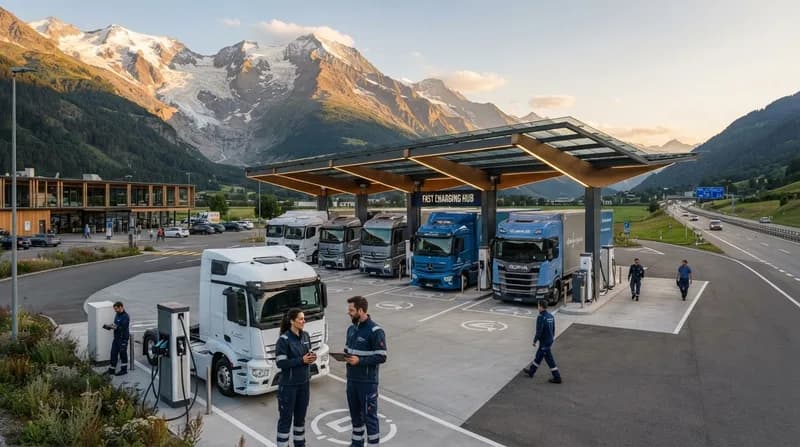
Switzerland’s Federal Roads Office (FEDRO) has taken a decisive step in its Electromobility Roadmap 2030 by finalizing the award for a nationwide truck-specific charging network. Following a competitive tender process that drew eleven distinct bids, the project will see the construction of 82 fast-charging stations across 32 key sites along the nation’s primary road network. This infrastructure rollout is critical, as Switzerland currently stands as a European leader in heavy-duty electrification, boasting a 27.4% market share for new electric commercial vehicles over 3.5 tonnes.
The project is divided into three distinct geographic and administrative lots. Each winner is responsible for the design, construction, and long-term operation of their respective sites. To ensure rapid deployment, the Swiss government is handling the pre-financing of power grid connections, with operating companies later reimbursing these costs through annual fees. The development timeline is aggressive, with the first stations expected to come online by 2030 and full network completion targeted for 2035.
1. Fastned (Lot 1)
Fastned Switzerland AG has secured Lot 1, encompassing eleven of the 32 designated locations. While the company is primarily recognized for its extensive passenger car charging network, it has been actively pivoting toward heavy-duty logistics since 2025, with existing deployments in Belgium and the Netherlands. Fastned has signaled a commitment to performance, promising a minimum output of 400 kW per CCS charging point, which exceeds the government's minimum requirement of 350 kW.
By leveraging its proven modular design philosophy, Fastned aims to integrate seamlessly into Switzerland’s transit corridors. The company views the Swiss market as a critical proof point for heavy-duty electric transport, emphasizing that building robust, high-power infrastructure is the only way to keep pace with the rapidly growing population of electric trucks currently traversing the Alps.
2. Obornes (Lot 2)
Lot 2 was awarded to Obornes SA, a subsidiary of the French Ortec Group. Operating under the Oreve brand, Obornes specializes in the end-to-end management of high-power charging assets, covering everything from construction to long-term maintenance. Their business model centers on creating turnkey solutions, often collaborating directly with fleet operators and site owners to ensure that the hardware is optimized for heavy vehicle ergonomics and high-throughput demands.
Their involvement in the Swiss network represents a strategic expansion of their European footprint. By securing ten locations within the Swiss tender, Obornes will apply its expertise in site optimization and high-availability operations to ensure that these national road charging hubs remain reliable cornerstones of the Swiss logistics chain.
3. Milence (Lot 3)
Milence, the well-known joint venture between industry giants Daimler Truck, Traton, and the Volvo Group, secured Lot 3, covering eleven locations. As a major player in the European market, Milence has already established 42 charging parks across nine countries. Switzerland marks the company's first major entry into the Swiss market, a move intended to bolster connectivity for international freight corridors passing through the country.
For Milence, this project is about more than just Swiss internal infrastructure; it is about bridging the gap between European transport nodes. By installing next-generation equipment, including several Megawatt Charging System (MCS) points, the joint venture aims to prove that heavy-duty, long-haul electric transport is viable at scale. The company believes this project is a prime example of how public and private sectors can synchronize to eliminate the barriers to zero-emission freight.
Why it Matters
- Infrastructure Hurdles: By standardizing high-power CCS (350kW+) and integrating MCS (Megawatt Charging System) hardware, the plan directly addresses the range and downtime anxiety that currently limits the adoption of electric heavy-duty vehicles.
- Strategic Location: Situated in the heart of Europe, Switzerland’s success in electrifying its transit routes serves as a blueprint for cross-border logistics in the EU.
- Regulatory Support: The government's decision to pre-finance grid connections significantly lowers the barrier to entry, de-risking the project for private investors and accelerating the construction timeline.