The Critical Window for Cardiac Survival
Out-of-hospital cardiac arrest (OHCA) represents one of the most pressing challenges in emergency medicine. Survival rates are directly tied to how quickly a patient receives high-quality cardiopulmonary resuscitation (CPR) and, crucially, defibrillation. Every minute that passes after an arrest significantly diminishes the chances of recovery, making the rapid delivery of an Automated External Defibrillator (AED) the difference between life and death. Traditional emergency response often struggles with this, as fixed AED locations are frequently sparse, particularly in rural regions or densely packed urban centers where traffic congestion can paralyze standard ground ambulances.
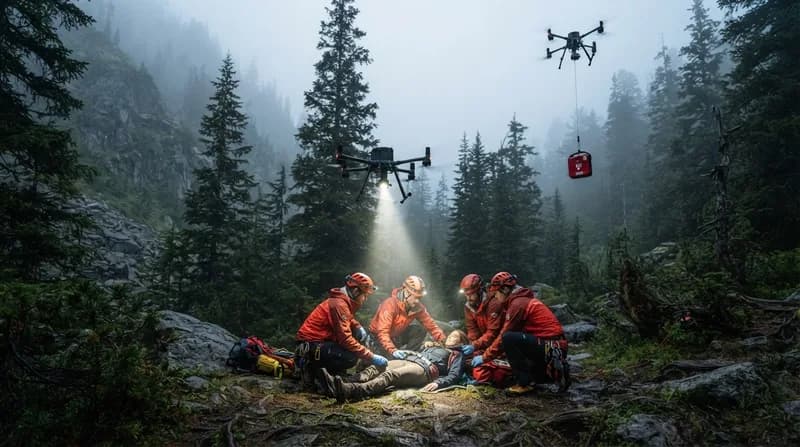
New research presented at the European Emergency Medicine Congress offers a potential technological solution: the deployment of autonomous drones to deliver life-saving equipment. By bypassing road traffic, these aerial vehicles aim to bridge the gap between a cardiac event being reported and the arrival of professional emergency responders.
The Hybrid Simulation Strategy
A recent study conducted by Dr. Hillary Minka and colleagues at Lariboisière Hospital in Paris utilized sophisticated computer modeling to evaluate the efficacy of drones across seven administrative departments in the Île-de-France region. The team analyzed three distinct strategies: expanding the existing network of fixed AEDs, relying solely on drone deliveries, and a hybrid approach that integrates both.
The findings were striking. Relying on ground-based transport from existing locations resulted in AEDs arriving within five minutes in only 30% to 40% of cases. In contrast, the hybrid model—deploying 200 drone bases alongside 871 strategically placed fixed AEDs—was projected to reach nearly 99.4% of cardiac arrest cases within the same timeframe. By optimizing the geographical placement of these assets, the researchers demonstrated that drones could extend the effective reach of emergency aid to 3,900 meters, a significant improvement over the 500-meter range typical of fixed-only networks.
Why It Matters
- Reduced Response Times: The study found that drone-supported networks reduced the average time to defibrillation by nearly four minutes across all surveyed areas, with some rural or congested urban locations seeing improvements exceeding 10 minutes.
- Optimized Resource Allocation: Rather than installing thousands of additional fixed AEDs, which may be underutilized, a hybrid strategy allows emergency services to cover a wider area with fewer permanent installations.
- Human-Machine Collaboration: The drone system does not replace the need for emergency responders or bystanders. Instead, it functions as an additional "link in the chain of survival," providing a bystander with the necessary equipment to perform life-saving interventions while waiting for professional medical teams.
Implications for Future Emergency Services
While the simulation highlights the massive potential of drone-enabled rescue, experts caution that it is not a silver bullet. The research serves as a theoretical foundation that must now be validated through real-world experiments and prospective clinical studies. Furthermore, the effectiveness of an AED is entirely dependent on the person on the scene. Dr. Felix Lorang, head of the emergency department at Klinikum Lippe, noted that technology is only as effective as the public's ability to use it. Consequently, widespread CPR and AED training remains the most critical companion to any hardware-based innovation.
As regulatory frameworks for autonomous flight evolve, the integration of drones into emergency response could represent a major shift in how public health crises are managed. By moving beyond the limitations of ground travel, medical systems could soon ensure that life-saving technology is never more than a few minutes away, regardless of geography or traffic conditions.