A New Timeline for Homo erectus
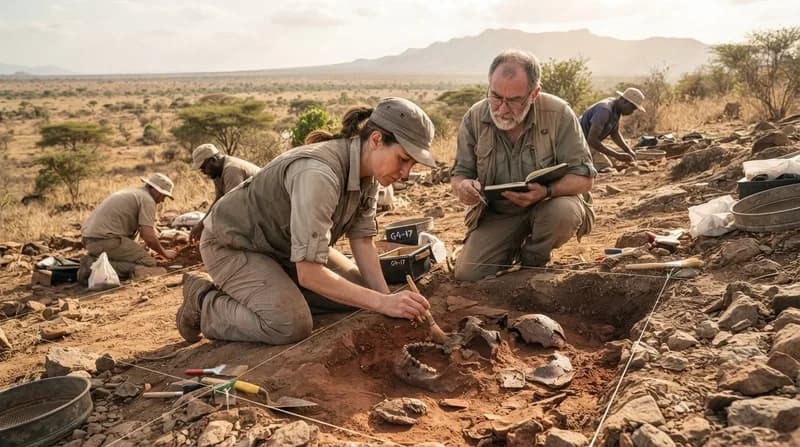
In a major revelation for paleoanthropology, researchers from La Trobe University have unearthed evidence that significantly alters our understanding of human origins. By analyzing 18 newly described hominin fossils from the Drimolen Main Quarry in South Africa, the team has confirmed the presence of Homo erectus as early as 2 million years ago. This discovery effectively pushes the timeline for the species back by 200,000 years, challenging long-held assumptions about when our direct ancestors first emerged.
The centerpiece of this find is an adult skull fragment, cataloged as DNH 127. Previously, the earliest evidence of Homo erectus in the region came from a juvenile fossil, which left room for debate regarding the physical characteristics of adults at that stage. By providing a confirmed adult specimen, the research offers a definitive anchor for the species' presence in southern Africa at the 2-million-year mark, predating findings from other significant sites like Dmanisi in Georgia.
Divergent Evolutionary Paths
The Drimolen site also provided a wealth of information regarding Paranthropus robustus, a species that coexisted with Homo erectus but followed a drastically different evolutionary trajectory. While Homo erectus was trending toward larger brain volumes and smaller, more versatile teeth—likely spurred by a diet incorporating more meat—P. robustus was doubling down on physical specialization.
Over a span of 200,000 years, the P. robustus population at Drimolen developed increasingly massive molars and powerful jaw muscles. These adaptations allowed them to process tough, fibrous vegetation, functioning much like a biological mortar and pestle. This stark contrast highlights that our ancestors were by no means the dominant species at the time; in fact, fossils suggest that P. robustus outnumbered Homo erectus by a ratio of more than 10 to 1, painting a picture of an early human lineage that was arguably an underdog in a competitive, shifting landscape.
Why It Matters
- Reshaping History: Pushing the appearance of Homo erectus to 2 million years ago forces scientists to recalibrate models of how and when early humans dispersed across the globe.
- Micro-Evolutionary Insights: The large cache of fossils allows researchers to observe "evolution in action" by comparing populations over a 200,000-year window, a rare opportunity given the typical scarcity of the fossil record.
- Redefining Success: The sheer number of P. robustus fossils compared to Homo erectus serves as a reminder that survival and dominance are not guaranteed, even for the lineages that eventually lead to modern humans.
Evolution Captured in Stone
The meticulous analysis of these fossils has provided enough evidence to officially designate the Drimolen population of P. robustus as a distinct subspecies, P. robustus ukusa. The transition observed in these specimens provides unprecedented clarity on how environmental and climatic pressures influenced the physical traits of hominins. Because fossil finds are traditionally fragmented, researchers have often had to rely on educated guesses to fill the gaps in the evolutionary story.
However, the density of findings at Drimolen—a site that has been under intermittent investigation since 1992—has yielded a high enough volume of remains to move beyond speculation. By documenting these subtle but consistent changes in teeth and skull structure, the research team has successfully mapped a timeline of micro-evolutionary change. This work reinforces the idea that the human family tree is not a linear progression, but a complex, branching web where multiple species adapted to their unique niches, even as one eventually outpaced the others in the long run of history.