ScienceTechnical Deep Dive

Rewriting Earth’s History: Rethinking a 2-Billion-Year-Old Geological Puzzle

Published
EElectricBuzz Editorial Team
Rewriting Earth’s History: Rethinking a 2-Billion-Year-Old Geological Puzzle
3 min read478 wordsElectricBuzz Editorial Team

The Gist

“New research suggests a landmark chemical signature from Earth's past, once thought to represent a global climate event, may actually be the result of localized volcanic heating.”

The Shunga-Francevillian Event Re-examined

For decades, geologists have pointed to a specific, 2-billion-year-old isotopic signature as the "smoking gun" for a massive, planet-wide disruption of the carbon cycle. Occurring during the Paleoproterozoic era, this signal—found in rocks from both Russia and Gabon—was widely interpreted as evidence that the young Earth's climate system underwent a violent, global-scale shift as oxygen first accumulated in the atmosphere. However, a new study from researchers at Caltech suggests that this long-held interpretation may be flawed, pointing toward a more localized geological explanation.

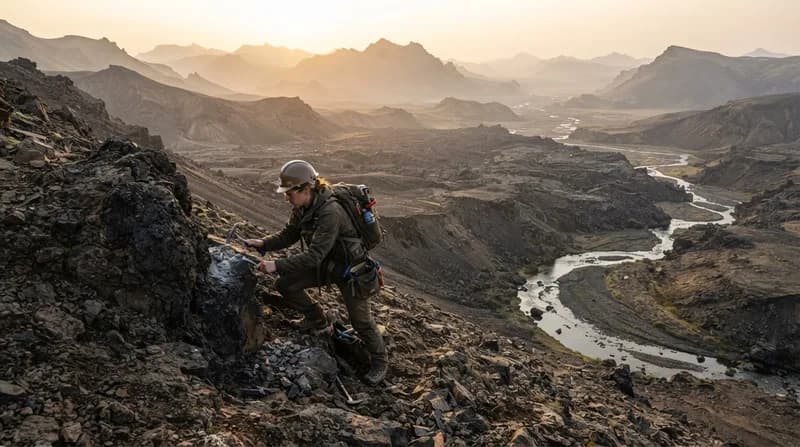
By examining drill cores from the Zaonega Formation in Karelia, Russia, the research team analyzed gases trapped in microscopic fluid inclusions within pyrobitumen-rich rocks. Their findings indicate that the isotopic "fingerprint" often cited as evidence of a global catastrophe may instead have been produced by distinct, regional events involving magma intrusions, underground hydrocarbon generation, and methane-consuming microbes.

The Role of Magma and Microbes

The research team proposes a mechanical process that explains the unusual carbon signatures without requiring a global environmental crisis. According to the study, a massive sheet of magma forced its way through marine sediments roughly 2 billion years ago, while the site was still beneath a prehistoric ocean. The intense heat from this intrusion served as a geological engine, warming sediments rich in organic matter and effectively "cooking" them.

This thermal process generated hydrocarbons—including methane and propane—which migrated upward through the sedimentary layers. Near the seafloor, these gases served as a fuel source for methane-eating microbes. These microorganisms, in turn, produced biomass that carried a specific light carbon isotope signature. This unique biological and thermal interaction left a permanent, albeit localized, mark on the rock record that closely mirrors the signatures scientists have long attributed to planetary-scale oxygenation events.

Why It Matters

This discovery highlights the necessity of re-evaluating the "reference sites" we use to construct the timeline of Earth's history. The Zaonega Formation has served as a benchmark for understanding the Shunga-Francevillian event; if the signal there is revealed to be a regional anomaly rather than a global phenomenon, our understanding of the early Earth's carbon cycle must be recalibrated. This research serves as a reminder that geological archives are complex, and the interpretation of ancient clues often requires a delicate balance between local geochemical context and planetary-scale trends.

Future Implications for Geochemistry

The research team is not stopping at the Russian samples. To verify if their theory holds true on a broader scale, they are now shifting their attention to rock samples from the Francevillian Basin in Gabon. The team recently coordinated an international drilling campaign to extract fresh cores, which are currently being prepared for comprehensive analysis. By comparing the findings from these two sites, scientists hope to clarify whether the Shunga-Francevillian event is truly a widespread indicator of early atmospheric transformation or merely a series of fascinating, localized geological events that were previously misunderstood.

SPONSORED
The 5 Best Over-Ear ANC Headphones of 2026, Tested & Ranked
Editor's Pick Guide
92/100
Tech & Gadgets•12 min read

The 5 Best Over-Ear ANC Headphones of 2026, Tested & Ranked

We locked five over-ear ANC picks for 2026 — Sony WH-1000XM6, Bose QuietComfort Ultra 2, Soundcore Space One, Sennheiser Momentum 5, and Apple AirPods Max 2 — then stress-tested them on lab metrics, long-term owner truth, and live street prices.

Related Stories

Semantically matched articles, ranked by topic overlap and freshness.

The REM Paradox: Why Your Brain Works Overtime While You Sleep
Science

The REM Paradox: Why Your Brain Works Overtime While You Sleep

New research from Tohoku University reveals that the brain's energy consumption spikes during REM sleep, even as the body attempts to bolster its fuel supply.

The Invisible Danger: How Scented Cleaners Create Indoor Air Pollution
Science

The Invisible Danger: How Scented Cleaners Create Indoor Air Pollution

New research from Purdue University reveals that the 'fresh' scent of household cleaners triggers chemical reactions, releasing billions of lung-penetrating nanoparticles into your home.

Smartwatch Calorie Tracking: Why Body Composition Matters
Science

Smartwatch Calorie Tracking: Why Body Composition Matters

A new study reveals that popular wearable devices struggle to accurately track calories, with error rates spiking significantly in users with higher body fat percentages.

Quantum Leap: Scientists Simulate Matter Creating Itself from Pure Energy
Science

Quantum Leap: Scientists Simulate Matter Creating Itself from Pure Energy

Researchers have successfully used a trapped-ion quantum simulator to observe the fundamental physics of 'string breaking,' a phenomenon that mimics how matter formed in the early universe.

Beyond Appetite: How Tirzepatide Could Unlock Fat-Burning Potential
Science

Beyond Appetite: How Tirzepatide Could Unlock Fat-Burning Potential

A groundbreaking study in mice reveals that popular weight-loss drugs Mounjaro and Zepbound may actively trigger the body's calorie-burning brown fat, offering new hope for metabolic health.

Bitget Crypto Exchange Hit by $387.5 Million Heist Linked to North Korean Actors
Science

Bitget Crypto Exchange Hit by $387.5 Million Heist Linked to North Korean Actors

Major crypto exchange Bitget has confirmed a massive $387.5 million security breach, with leadership pointing to state-sponsored North Korean actors as the likely culprits.

Hidden in the Rocks: Two New Snail Species Discovered in Montenegro's Rugged Canyons
Science

Hidden in the Rocks: Two New Snail Species Discovered in Montenegro's Rugged Canyons

Scientists and citizen researchers have identified two unique, trapdoor-shutting snail species in Montenegro, highlighting both the region's hidden biodiversity and the urgent threats posed by industrial development.

Landmark Swedish Study Links Congenital Infections to Neurodevelopmental Risks
Science

Landmark Swedish Study Links Congenital Infections to Neurodevelopmental Risks

A massive longitudinal study tracking 3.7 million individuals reveals that rare prenatal infections significantly elevate the risk of autism and intellectual disabilities later in life.