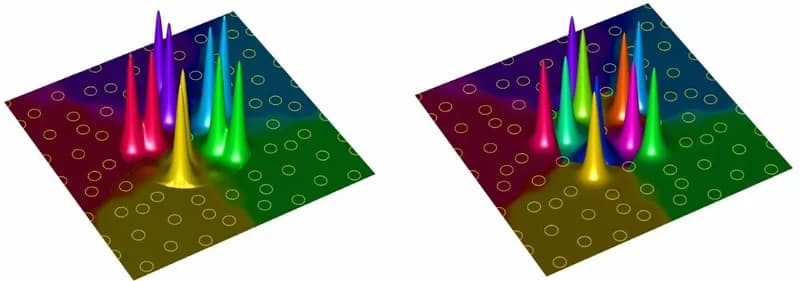
Researchers have developed a novel technique to manipulate light by utilizing the unique structural properties of quasicrystals. By intentionally introducing specific defects into these materials, scientists have successfully demonstrated the ability to trap and twist light beams into stable configurations.
Engineering Optical Defects
Unlike traditional crystals, which have a repeating periodic structure, quasicrystals possess an ordered but non-repeating pattern. This complexity allows for greater flexibility in how light interacts with the material. The research team found that by reshaping the quasicrystal lattice with precisely designed defects, they could create localized regions where light is forced into a helical or twisting path.
Potential Applications
The ability to control twisting beams of light—often referred to as orbital angular momentum—has significant implications for various fields. This discovery could pave the way for advancements in high-capacity optical communications, precision sensing, and the development of new types of optical tweezers for micromanipulation. By providing a stable environment for these complex light patterns, quasicrystals offer a promising platform for next-generation photonic devices.