The Emergence of Synchronized Time Crystals
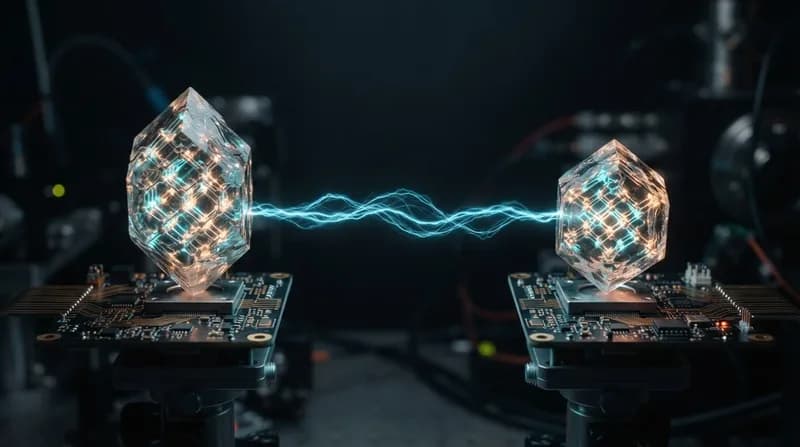
In a fascinating leap for quantum physics, researchers at TU Dortmund University have successfully demonstrated that time crystals—exotic, self-oscillating systems—can lock into a shared rhythm even when separated by significant distances. This phenomenon, which echoes the historical observations of Christiaan Huygens regarding pendulum clocks, reveals that these quantum structures interact through the movement of spin-polarized electrons within a semiconductor.
Time crystals are unique because their internal state repeats in a regular, stable rhythm without the need for an external, periodic driver. While the existence of these crystals has been a focus of recent research, the ability to control their behavior and induce synchronization across a material marks a significant evolution in our understanding of these systems.
The Mechanics of Coupling
The experiment utilized a semiconductor composed of gallium arsenide, infused with trace amounts of indium and silicon. These dopants create localized sites for electron interaction. By chilling the material to a frigid -270 degrees Celsius and employing a precise pump laser, the team initiated electron spin polarization. This polarization is then transferred to the surrounding nuclear spins, creating a feedback loop between electron and nuclear spins that sustains the characteristic oscillation of the crystal.
Under normal conditions, microscopic variations in the semiconductor would cause these independent time crystals to oscillate at slightly different, unpredictable frequencies. However, by illuminating a broad region of the material with a laser beam, the researchers induced a state of collective synchronization. Instead of mechanical energy transfer, the coupling is facilitated by the exchange of spin-polarized electrons between the disparate crystals.
Why it Matters: Implications for Spintronics
The findings provide a major breakthrough for the field of spintronics—a technology that seeks to use the 'spin' of electrons, rather than just their charge, to store and process information. By proving that non-local coupling exists between spin systems, researchers have opened a pathway to creating complex networks of controllable oscillators.
- Long-Range Interaction: Crystals separated by up to 40 micrometers—a distance over 1,000 times larger than the oscillator itself—successfully synchronized.
- Scalable Control: The ability to lock separate regions into a unified frequency suggests that we could eventually construct large-scale, coherent quantum circuits.
- Material Innovation: The use of gallium arsenide proves that complex quantum behaviors can be maintained in engineered solid-state materials, moving the concept closer to practical application.
This discovery effectively lays the foundation for future devices that rely on synchronized spin states. By managing these oscillations, scientists could develop highly efficient, low-power computing components that move beyond the limitations of traditional silicon-based architecture, representing a vital step toward the next generation of quantum information systems.