E-BUZZ ME Logo
ScienceTechnical Deep Dive

Quantum Mini-Universe Suggests Time Emerges Without an External Clock

Published
Quantum Mini-Universe Suggests Time Emerges Without an External Clock
1 min read183 words

The Gist

Physicists at the University of Birmingham have demonstrated that the flow of time can emerge naturally from internal quantum changes rather than an external reference.

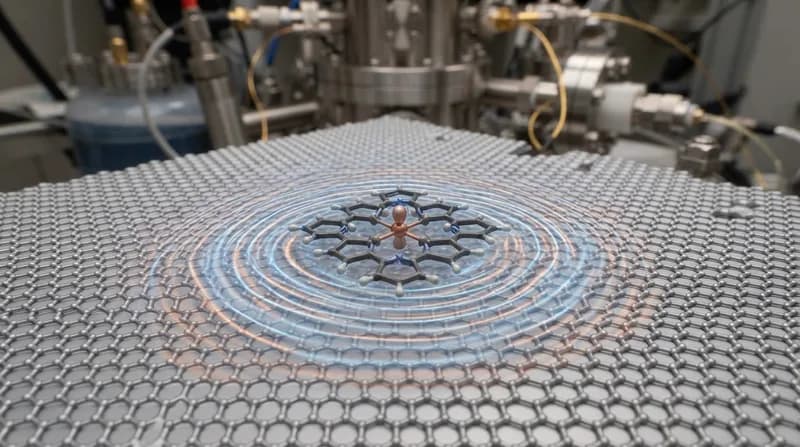
A groundbreaking experiment conducted by physicists at the University of Birmingham has challenged our fundamental understanding of temporal existence. By creating a 'mini-universe' composed of 24,000 ultracold atoms, researchers have successfully demonstrated that time can emerge as a consequence of internal dynamics rather than being an absolute external framework.

The Emergence of Quantum Time

The study explores a long-standing mystery in physics: whether time is a fundamental property of the universe or a secondary effect of physical change. In this controlled quantum system, the flow of time was observed to emerge naturally from the interactions and changes occurring within the atomic cluster. This process occurred without the presence of or reliance on any external clock or reference point.

Implications for Modern Physics

This discovery provides critical evidence for theories suggesting that time is an emergent property. By utilizing ultracold atoms, the team was able to isolate quantum behaviors that are usually obscured in larger, warmer systems. The results suggest that in the absence of change, time as we perceive it might not actually exist, potentially bridging gaps between general relativity and quantum mechanics.

Related Stories

Semantically matched articles, ranked by topic overlap and freshness.

Quarks and Qubits: The Quantum Computing Revolution in Particle Physics
Science65%

Quarks and Qubits: The Quantum Computing Revolution in Particle Physics

New research explores how the intersection of quantum information and general relativity could redefine our understanding of subatomic particles.

Unlocking New Conductivity Pathways in Mott Insulators
Science65%

Unlocking New Conductivity Pathways in Mott Insulators

Recent research into laser-driven feedback effects in Mott insulators reveals groundbreaking methods for engineering conductivity in strongly interacting systems.

New Study Challenges the Existence of Dark Energy
Science65%

New Study Challenges the Existence of Dark Energy

A controversial research paper suggests that the universe’s expansion may not be accelerating, potentially eliminating the need for dark energy as a scientific explanation.

Breakthrough Fluoride-Free Gel Could Regrow Damaged Tooth Enamel
Science65%

Breakthrough Fluoride-Free Gel Could Regrow Damaged Tooth Enamel

Researchers have developed a protein-inspired gel that mimics natural tooth formation to repair microscopic cracks and rebuild enamel.

Fields Medal 2026: Mathematicians Honored for Unifying Physics Laws
Science64%

Fields Medal 2026: Mathematicians Honored for Unifying Physics Laws

The prestigious Fields Medal has been awarded to mathematicians whose groundbreaking work bridges the gap between geometry and the fundamental laws of physics.

Predictable Antarctic Ice Loss Offers Decades for Sea Level Preparation
Science63%

Predictable Antarctic Ice Loss Offers Decades for Sea Level Preparation

New research suggests that Antarctic ice retreat may remain predictable through 2050, giving governments a critical window to implement coastal defenses.

Simple AI Prompt Resolves Decades-Old Mathematical Conjecture
Science63%

Simple AI Prompt Resolves Decades-Old Mathematical Conjecture

For the second time in a week, artificial intelligence has disproved a long-standing mathematical conjecture using surprisingly basic prompts.

Neural Switch Discovered Controlling Bee Colony Labor Division
Science63%

Neural Switch Discovered Controlling Bee Colony Labor Division

Researchers have identified specific brain circuits that dictate the professional roles of honeybees as they age.