ScienceTechnical Deep Dive

Quantum Leap: New Hybrid Material Uses Voltage to Control Exciton Transport

Published
EElectricBuzz Editorial Team
Quantum Leap: New Hybrid Material Uses Voltage to Control Exciton Transport
3 min read419 wordsElectricBuzz Editorial Team

The Gist

Researchers have unlocked a breakthrough in 2D material science, enabling electrical control over exciton transport and valley polarization without precise alignment constraints.

A New Frontier for Information Processing

Modern computing relies heavily on the movement of electrons, while telecommunications utilize the speed of light. Now, a research breakthrough involving a perovskite-WS2 heterostructure suggests that a third path—using excitons—is becoming increasingly viable. Excitons, which are effectively bound electron-hole pairs, act as a unique bridge between electrical charge and light, offering the potential for faster, more energy-efficient information transmission.

Previous attempts to harness excitons for data transport faced significant hurdles. Typically, these particles have a fleeting existence before they recombine. While researchers have previously used stacked transition-metal dichalcogenides to extend exciton lifespans, these efforts often required incredibly precise, nanoscopic rotational alignment between layers—a process that is difficult to scale for commercial manufacturing. This new hybrid perovskite approach bypasses that requirement entirely, simplifying the pathway toward mass-produced excitonic circuits.

Voltage-Controlled Switching

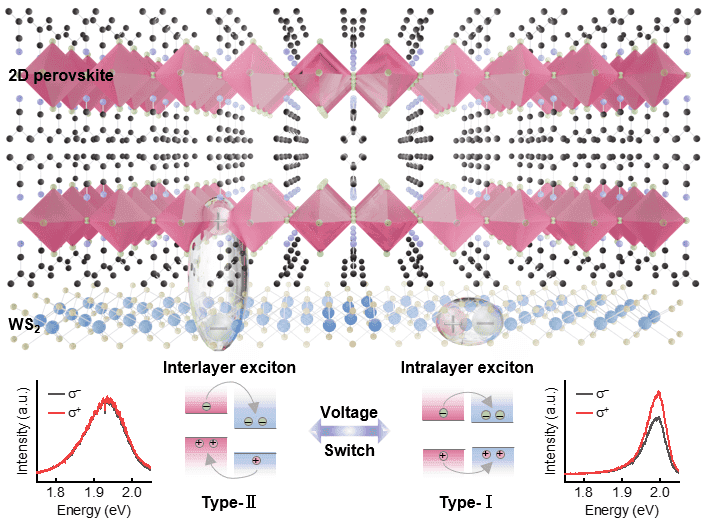
The core innovation lies in the material's ability to switch its exciton state based on an external voltage. By applying different electrical potentials to the heterostructure, the team can effectively toggle between interlayer and intralayer exciton states. This functionality dictates whether excitons remain localized or migrate across the material, providing a dynamic 'on-off' mechanism for energy transport that functions at the 2D material level.

Beyond simple transport, the researchers also achieved electrical control over valley polarization. In the context of 'valleytronics,' information is encoded into the energy minima of the material's electronic band structure. By using voltage to switch between high and low valley-polarization states, the researchers have demonstrated that it is possible to process information within these 'valleys'—an essential prerequisite for next-generation, high-speed computing hardware that moves beyond standard silicon-based architectures.

Why It Matters

  • Scalability: By removing the need for precise twist-angle alignment, this discovery makes the development of 2D material circuits significantly more feasible for real-world integration.
  • Dual Functionality: The ability to electrically control both energy transport and information polarization within a single heterostructure creates a blueprint for hybrid exciton-valleytronic devices.
  • Energy Efficiency: Excitons offer lower energy dissipation compared to traditional electronic currents, potentially leading to a new class of low-power processors and sensors.

Implications for the Future

This study represents a major milestone in the field of condensed matter physics and nanophotonics. While still in the research phase, the ability to electrically manipulate the fundamental behavior of excitons suggests a future where logic and memory devices are no longer confined by the limitations of traditional electron-based transport. As the industry looks for post-silicon solutions, these hybrid perovskite materials are emerging as leading candidates for the next generation of optoelectronic technology.


The 5 Best Over-Ear ANC Headphones of 2026, Tested & Ranked
Editor's Pick Guide
92/100
Tech & Gadgets12 min read

The 5 Best Over-Ear ANC Headphones of 2026, Tested & Ranked

We locked five over-ear ANC picks for 2026 — Sony WH-1000XM6, Bose QuietComfort Ultra 2, Soundcore Space One, Sennheiser Momentum 5, and Apple AirPods Max 2 — then stress-tested them on lab metrics, long-term owner truth, and live street prices.

Related Stories

Semantically matched articles, ranked by topic overlap and freshness.

Breaking Barriers: New Research Reveals People with Dementia Are Eager to Contribute to Science
Science

Breaking Barriers: New Research Reveals People with Dementia Are Eager to Contribute to Science

A groundbreaking study challenges long-standing assumptions, revealing that individuals with dementia find research participation meaningful rather than burdensome.

New Piezoelectric Microprobe Revolutionizes Intravascular Imaging for Brain Health
Science

New Piezoelectric Microprobe Revolutionizes Intravascular Imaging for Brain Health

Researchers have developed a breakthrough 0.55 mm diameter microprobe capable of navigating the brain's tiny blood vessels to provide high-resolution, 360-degree diagnostic imaging.

Unlocking the Immune System: New Genetic Target Found to Reverse T-Cell Exhaustion
Science

Unlocking the Immune System: New Genetic Target Found to Reverse T-Cell Exhaustion

Researchers at St. Jude Children's Research Hospital have identified a 'master regulator' gene that suppresses immune function, offering a promising new path for cancer immunotherapy.

The Tri-Generation Breakthrough: How SMRs Could Solve Energy, Water, and Fuel Crises
Science

The Tri-Generation Breakthrough: How SMRs Could Solve Energy, Water, and Fuel Crises

A revolutionary new energy system design leverages small modular nuclear reactors to simultaneously churn out clean electricity, green hydrogen, and desalinated freshwater.

AI Agents Slash Tumor Digital Twin Development Time from Months to Minutes
Science

AI Agents Slash Tumor Digital Twin Development Time from Months to Minutes

Researchers at the Barcelona Supercomputing Center have unveiled an AI-powered interface that allows biologists to generate complex cancer models through simple conversation, eliminating the need for extensive coding.

Could 40Hz Sensory Stimulation Be the Missing Link in Sickle Cell Pain Management?
Science

Could 40Hz Sensory Stimulation Be the Missing Link in Sickle Cell Pain Management?

Researchers at Virginia Commonwealth University have discovered that non-invasive light and sound therapy can help clear brain waste, potentially alleviating chronic pain associated with sickle cell disease.

Thirty Meter Telescope Rejects La Palma: The High-Stakes Path Back to Mauna Kea
Science

Thirty Meter Telescope Rejects La Palma: The High-Stakes Path Back to Mauna Kea

The Thirty Meter Telescope project has officially declined a €1bn relocation offer to Spain, reaffirming its commitment to the Hawaiian summit of Mauna Kea.

A Rare Glimpse Into Whale Grief: Humpback Mother’s Extended Vigil
Science

A Rare Glimpse Into Whale Grief: Humpback Mother’s Extended Vigil

Researchers have documented a rare, poignant display of maternal mourning in humpback whales, providing new insight into the complex emotional lives of marine giants.