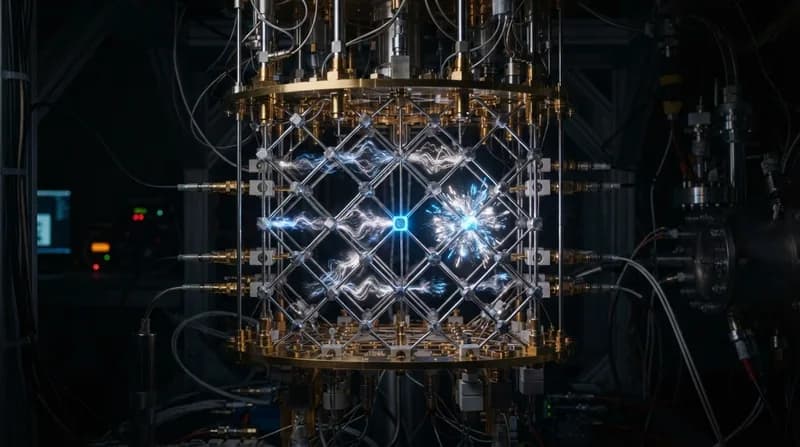
The Quantum Nature of Sound
In our everyday experience, sound is a fluid, continuous phenomenon. When a bell tolls, its vibrations fade away in a smooth, predictable decay. However, when viewed through the lens of quantum mechanics, this behavior is revealed to be far more granular. Just as light is composed of individual particles called photons, sound is made up of discrete packets of vibrational energy known as phonons. For decades, the ability to observe these phonons as they transition between energy states—a process known as a quantum jump—has remained elusive.
A team of researchers at Stanford University has now successfully documented these quantum jumps in a mechanical resonator in real time. Published in the journal Science, this achievement bridges a century-old gap in quantum theory. By watching a phonon abruptly vanish from one energy state and reappear in another, the team has proven that mechanical, vibrating objects can exhibit the same discrete, quantized behaviors previously restricted to atomic particles and light.
The Engineering Marvel: A Long-Lived Resonator
The success of the experiment relied on the creation of a specialized mechanical resonator fabricated using high-end chip techniques. To make the fleeting jumps visible, the team had to engineer a device with an unusually long "ringdown time." The resonator acts essentially as a microscopic tuning fork, capable of vibrating for two milliseconds. While that duration seems short, it is exceptionally long in the context of quantum physics, providing a stable window for the researchers to capture hundreds of precise measurements before the vibrational energy dissipated.
Integrating this tiny mechanical component with the rest of the experimental apparatus posed a significant challenge. The researchers utilized a superconducting qubit—a circuit designed to store quantum information—to act as the primary detector. By carefully coupling the resonator to the qubit, the team could probe the mechanical system without collapsing or disturbing the delicate quantum state they were attempting to observe.
Why It Matters
- Quantum Computing Stability: Monitoring quantum jumps is essential for error correction in quantum processors, where these jumps often serve as indicators of system instability.
- Advanced Biological Sensors: The high sensitivity of this system could eventually be leveraged to detect and identify individual proteins within biological cells.
- Next-Generation Electronics: By gaining granular control over phonons, engineers may be able to refine sound-based technologies found in modern smartphones and communication hardware, leading to unprecedented levels of device precision.
A New Era for Quantum Sensing
The implications of this study extend well beyond theoretical physics. As quantum computers move toward practical application, the ability to detect and correct errors in real time remains the industry’s "holy grail." Because a quantum jump often signals that a system has deviated from its intended path, the ability to monitor these transitions in phonons provides a powerful new diagnostic tool. The researchers are already exploring collaborative efforts to apply this detection platform to high-resolution biological imaging, potentially identifying proteins that were previously too small or unstable to track.
Ultimately, this research suggests that sound is far more than a wave propagating through air; it is a fundamental quantum tool. As the team continues to refine their control over phonons, the potential to integrate these mechanical systems into larger, more complex computing architectures becomes increasingly viable, signaling a shift toward hybrid systems that leverage both electromagnetic and mechanical quantum states.