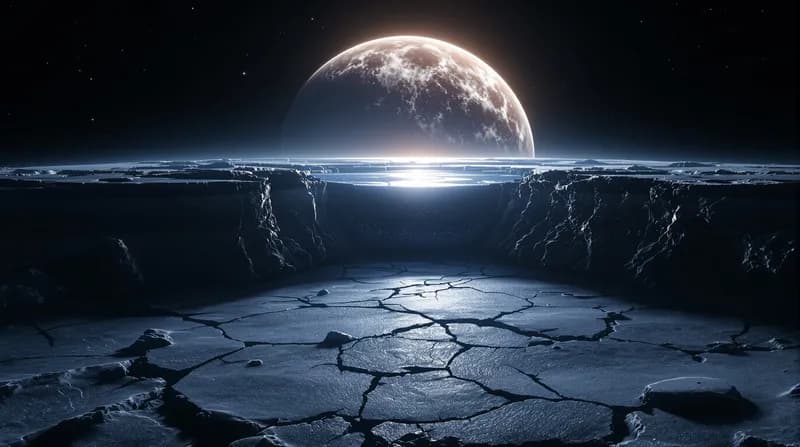
Jupiter's moon Europa has long been considered one of the most promising candidates in the search for extraterrestrial life due to its vast subsurface ocean. Scientists previously hypothesized that water from this deep ocean could rise through cracks in the icy shell, forming shallow, accessible reservoirs. However, recent simulations have cast doubt on this theory.
The Clogging Effect
New computer models indicate that as turbulent water travels through fractures toward the surface, it rapidly loses heat. This cooling process leads to the immediate formation of ice crystals, which can clog the narrow passages within hours. This thermal barrier makes it significantly less likely that liquid water reaches the upper layers of the moon's crust.
Impact on Future Missions
These findings present a new challenge for upcoming space missions designed to detect biosignatures. If water cannot easily migrate to the surface or form shallow pockets, future landers and orbiters may need to look deeper or find alternative ways to sample the moon's internal chemistry. While the subsurface ocean remains a target for study, the path to reaching it appears more obstructed than previously believed.