ScienceTechnical Deep Dive

Cracking the Code: NASA Unlocks the Secret Behind Bennu's Mysterious Thermal Behavior

Published
EElectricBuzz Editorial Team
Cracking the Code: NASA Unlocks the Secret Behind Bennu's Mysterious Thermal Behavior
3 min read494 wordsElectricBuzz Editorial Team

The Gist

“New laboratory analysis of samples returned by the OSIRIS-REx mission reveals that internal fracture networks are the secret behind the rapid heat loss of asteroid Bennu's massive boulders.”

A Puzzling Thermal Paradox

When NASA’s OSIRIS-REx spacecraft reached asteroid Bennu in 2018, it encountered a landscape that defied early expectations. Rather than the predicted patches of smooth, fine-grained regolith, the asteroid was littered with massive, jagged boulders. This discrepancy created a significant scientific headache: based on 2007 thermal data from the Spitzer Space Telescope, researchers knew the asteroid exhibited low thermal inertia, meaning it gained and lost heat rapidly. In Earthly terms, rocks usually behave like concrete—they hold onto heat for long periods. The mystery, therefore, was how a surface dominated by large, solid rocks could exhibit such uncharacteristically fast cooling.

The Role of Microscopic Architecture

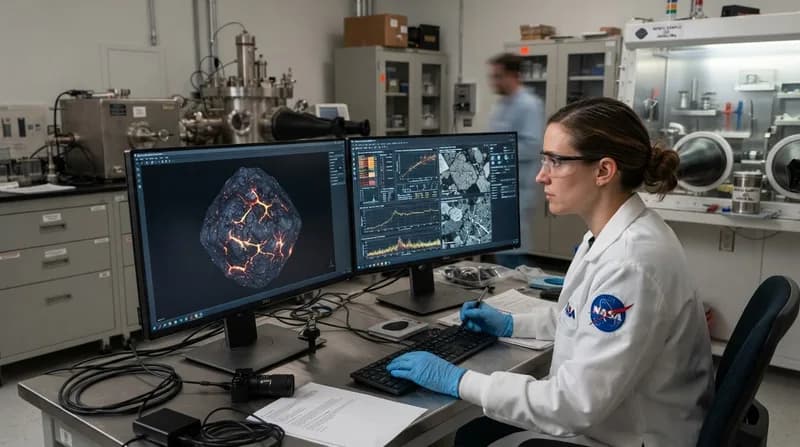
By bringing actual samples of Bennu back to Earth, researchers finally had the tools to investigate the physical properties of these enigmatic boulders. Through a combination of lock-in thermography and high-resolution 3D imaging, a team led by the University of Arizona discovered that the rocks are far from solid. While the material is naturally porous, the researchers identified that the true secret lies in extensive, complex networks of internal cracks. These fractures disrupt the transmission of heat, preventing the boulders from retaining energy in the way a solid, homogeneous rock would.

Key Findings from the Analysis

  • High Internal Porosity: The boulders contain significant empty space, reducing their overall mass and ability to hold heat.
  • Fracture Networks: Extensive, curved, and straight crack systems act as thermal barriers, facilitating rapid cooling as the asteroid rotates away from the Sun.
  • Discrepancy Resolution: Laboratory experiments on small particles initially showed higher thermal inertia than spacecraft readings; however, computer simulations confirmed that when scaled up to the size of asteroid boulders, these internal cracks perfectly explain the spacecraft's observations.

Non-Destructive Inspection via X-Ray Tomography

A critical component of this discovery involved advanced imaging techniques at NASA’s Johnson Space Center. To analyze the samples without risking degradation from Earth’s atmosphere, researchers utilized X-ray computed tomography (XCT). The particles were sealed in nitrogen-filled, airtight containers that acted as "spacesuits," allowing scientists to peer deep into the internal structure of the rocks in three dimensions without breaking the protective seal. This non-destructive methodology has created a permanent, publicly available digital database of the sample's physical architecture, ensuring these findings can be cross-referenced and analyzed by the global scientific community for years to come.

Why it Matters

This breakthrough provides a long-awaited "ground truth" for planetary science. Previously, astronomers were forced to estimate the composition and internal health of asteroids based solely on remote thermal signatures. Because these estimates were often hampered by a lack of physical samples, scientists were effectively guessing at the material properties. With the data from the OSIRIS-REx samples, researchers can now calibrate their models, allowing for much more accurate interpretations of telescope observations across the entire solar system. This doesn't just solve a puzzle about one asteroid; it refines our fundamental understanding of how rocky bodies in space are constructed and how they respond to the harsh environment of deep space.


SPONSORED
The 5 Best Over-Ear ANC Headphones of 2026, Tested & Ranked
Editor's Pick Guide
92/100
Tech & Gadgets•12 min read

The 5 Best Over-Ear ANC Headphones of 2026, Tested & Ranked

We locked five over-ear ANC picks for 2026 — Sony WH-1000XM6, Bose QuietComfort Ultra 2, Soundcore Space One, Sennheiser Momentum 5, and Apple AirPods Max 2 — then stress-tested them on lab metrics, long-term owner truth, and live street prices.

Related Stories

Semantically matched articles, ranked by topic overlap and freshness.

The Communication Gap: Why Improved Hurricane Maps Are Failing to Change Behavior
Science

The Communication Gap: Why Improved Hurricane Maps Are Failing to Change Behavior

New research from Florida State University suggests that while hurricane forecast graphics are becoming more technically accurate, they aren't effectively motivating the public to take life-saving precautions.

Bridging the Reality Gap: How VR and Wearables Are Transforming Parkinson’s Care
Science

Bridging the Reality Gap: How VR and Wearables Are Transforming Parkinson’s Care

Lehigh University researchers are leveraging virtual reality and wearable sensors to decode Parkinson’s-related gait impairments and personalize patient rehabilitation.

Precision Medicine: A New Soil-Derived Compound Could Revolutionize Gut Health
Science

Precision Medicine: A New Soil-Derived Compound Could Revolutionize Gut Health

Researchers have identified a natural compound that selectively eliminates harmful C. difficile bacteria while sparing the gut's vital microbiome.

A Breakthrough in Alzheimer’s: Protecting Brain Cells Without Removing Tau
Science

A Breakthrough in Alzheimer’s: Protecting Brain Cells Without Removing Tau

Researchers have discovered that blocking immune cell infiltration into the brain can significantly reduce neurodegeneration, even while toxic tau protein tangles persist.

FDA Approves Breakthrough Immunotherapy for Rectal Cancer Patients
Science

FDA Approves Breakthrough Immunotherapy for Rectal Cancer Patients

A new FDA-approved immunotherapy, Jemperli, is changing the landscape of rectal cancer treatment by allowing select patients to bypass traditional, life-altering therapies.

Beyond Memory Loss: The Evolutionary Case for the 'Wise' Aging Brain
Science

Beyond Memory Loss: The Evolutionary Case for the 'Wise' Aging Brain

A groundbreaking new hypothesis suggests that as the brain ages, it purposefully shifts away from storing granular details to prioritize the extraction of wisdom and pattern recognition.

Could Daily Vitamin C Supplements Combat Early-Stage Blood Cancer?
Science

Could Daily Vitamin C Supplements Combat Early-Stage Blood Cancer?

A groundbreaking clinical trial suggests that simple, daily vitamin C supplementation may significantly improve survival rates for patients with precancerous blood disorders.

Nigeria Initiates Emergency Response After First Confirmed Ebola Case
Science

Nigeria Initiates Emergency Response After First Confirmed Ebola Case

Health authorities in Nigeria have launched aggressive contact tracing protocols after confirming the nation's first Ebola case linked to the ongoing regional outbreak.