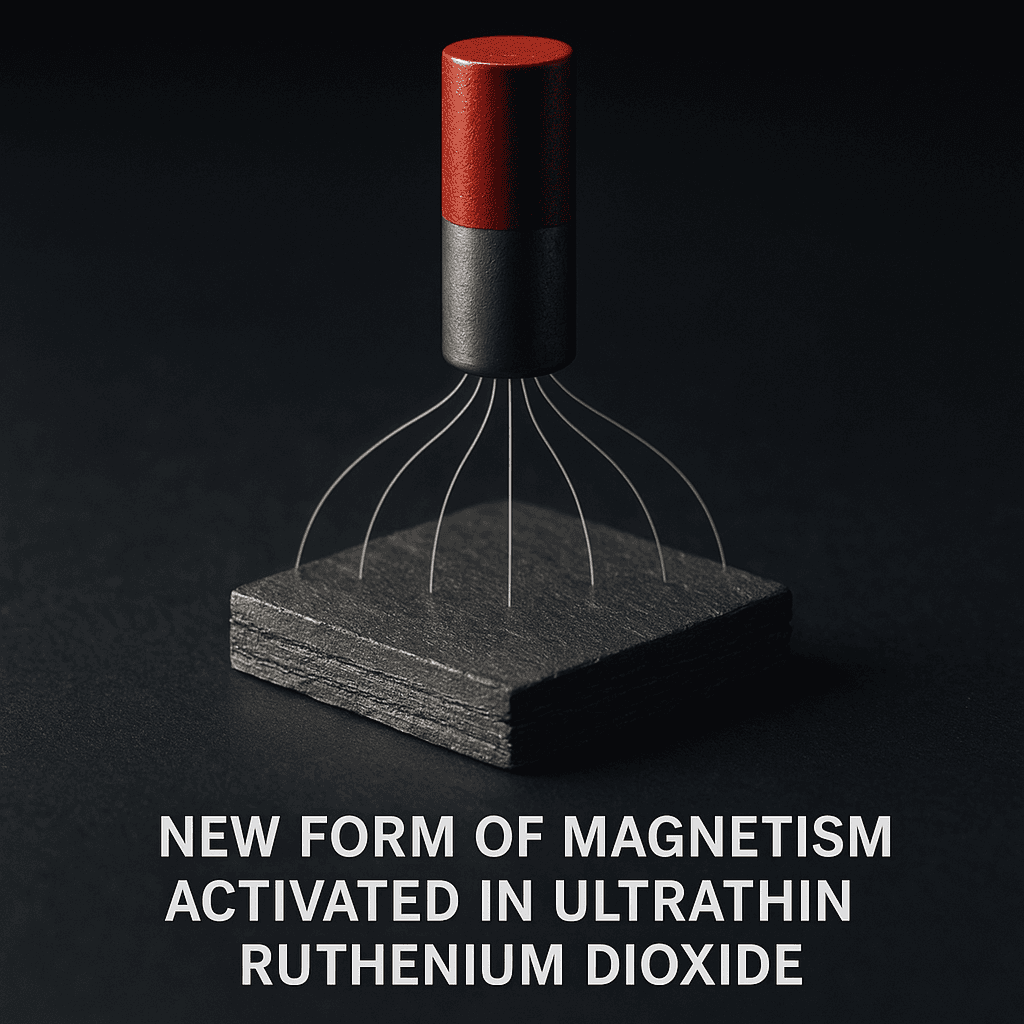
Researchers at Rice University have made a significant breakthrough by demonstrating a new form of magnetism known as altermagnetism in ultrathin films of ruthenium dioxide. When these films are subjected to atomic strain, they exhibit magnetic properties previously thought impossible.
Key Findings
- Ruthenium dioxide, traditionally considered nonmagnetic in bulk form, displays altermagnetism when thinned to just a few atomic layers and strained.
- This discovery implies that controlling lattice strain could allow precise manipulation of magnetic properties, essential for future spintronics applications and new designs in computer memory.
- The research, published in 'Science Advances', involved a collaboration between physicists from Rice University and the University of Minnesota, emphasizing the differences in behavior between bulk and ultrathin materials.
- Advanced techniques, such as spin-resolved angle-resolved photoemission spectroscopy, facilitated the observation of unique spin textures, revealing unconventional magnetism in the strained ultrathin samples.
- This work continues ongoing research into quantum materials, which pose significant challenges in comprehending their magnetic behaviors, especially concerning bulk ruthenium dioxide.
- The study was supported by funding from the U.S. Department of Energy and the Gordon and Betty Moore Foundation, highlighting its significance in the field of quantum material research.
This discovery not only challenges existing notions about the magnetic properties of ruthenium dioxide but also opens new avenues for technology in fields such as information storage and processing.