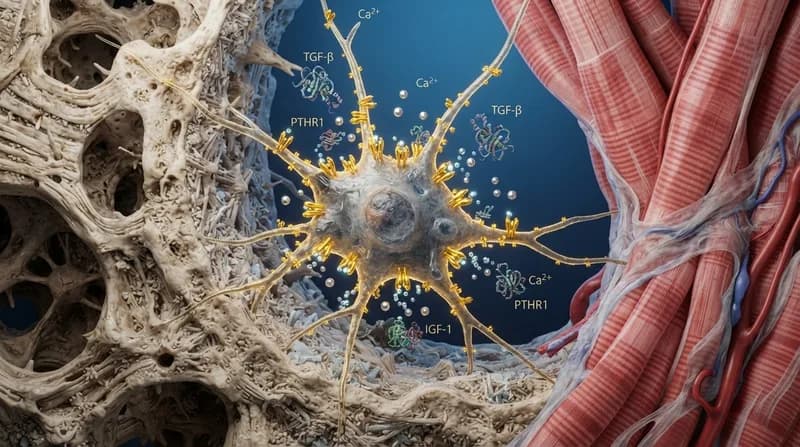
Targeting the GPR133 Receptor
Osteoporosis remains a significant global health challenge, affecting millions of individuals—particularly post-menopausal women—by gradually eroding bone density and increasing fracture risk. Current treatment protocols often face limitations, ranging from systemic side effects to restricted long-term efficacy. However, a team at Leipzig University has identified a promising new biological target: GPR133. This receptor, part of the adhesion G protein-coupled receptor (GPCR) family, acts as a critical interface on the cell surface, translating physical cues from the surrounding environment into internal cellular actions.
The research, recently published in the journal Signal Transduction and Targeted Therapy, highlights how GPR133 serves as a natural regulator of skeletal health. When this receptor is genetically impaired, studies show that bone density declines prematurely, mimicking the progression of human osteoporosis. By isolating this mechanism, the researchers have effectively identified a 'master switch' that, when toggled correctly, can influence the structural integrity of the skeletal system.
The Role of AP503
To test the efficacy of manipulating this receptor, scientists utilized an experimental compound known as AP503. Identified through advanced, computer-assisted screening, AP503 acts as a stimulator for GPR133. In experiments involving mice, the administration of this compound produced a marked improvement in bone strength across both healthy subjects and those already exhibiting signs of osteoporotic degeneration.
The mechanism behind this success lies in the balance between osteoblasts (bone-forming cells) and osteoclasts (bone-resorbing cells). Healthy skeletal turnover requires a delicate equilibrium between these two types of cells. AP503 shifts this balance by stimulating the activity of osteoblasts while simultaneously suppressing the destructive impact of osteoclasts. By imitating the natural activation process of the GPR133 receptor, AP503 provides a potential pharmacological pathway to restore lost bone mass rather than simply arresting further loss.
Why it Matters
- Dual-Action Potential: Previous studies from the same lab suggest AP503 may also enhance skeletal muscle strength, offering a two-pronged approach to treating age-related frailty.
- Targeted Therapy: By focusing on a specific receptor, this approach could minimize the systemic side effects often associated with hormone-based treatments.
- Addressing Sarcopenia and Osteoporosis: The combination of bone and muscle reinforcement is particularly vital for the aging population, as it directly impacts mobility, stability, and fracture prevention.
Future Implications for Geriatric Medicine
The implications of this discovery extend far beyond basic bone biology. As the global population ages, the convergence of osteoporosis and sarcopenia—the age-related loss of muscle mass—creates a heightened risk for falls and chronic injury. A singular treatment capable of fortifying both muscle and bone tissue could fundamentally alter the standard of care for geriatric patients.
Looking ahead, the Leipzig research team is continuing to probe the complexities of the GPR133 signaling pathway. Through the university's Collaborative Research Center 1423, investigators are deep-diving into the structural dynamics of GPCR activation to better understand how these receptors change shape and transmit signals. While the transition from mouse models to clinical applications requires rigorous further study, the identification of AP503 marks a significant milestone in the quest for regenerative therapies aimed at maintaining physical independence well into old age.