ScienceTechnical Deep Dive

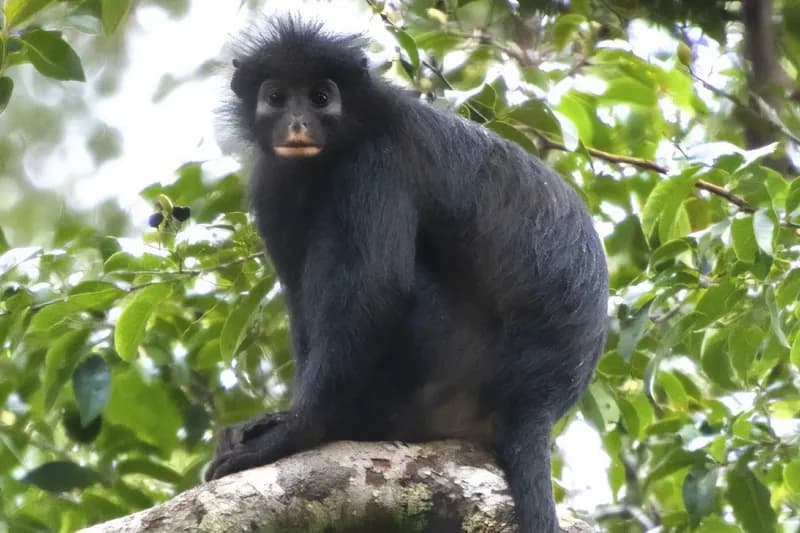
New Black Colobus Monkey Species Identified in Congo Basin

Published
EElectricBuzz Editorial Team
New Black Colobus Monkey Species Identified in Congo Basin
1 min read106 wordsElectricBuzz Editorial Team

The Gist

“A distinct species of black colobus monkey, known locally as the 'likweli,' has been identified by scientists in a remote region of the Congo Basin.”

Researchers have identified a new species of black colobus monkey inhabiting the dense rainforests of the Congo Basin. Characterized by a distinctive mask-like facial pattern and a notably strong body odor, the primate has long been recognized by local communities, who refer to it as the 'likweli.'

Threats to Survival

Despite its recent formal recognition in scientific circles, the species is already facing critical survival challenges. Experts indicate that the monkey is severely threatened by intense poaching activities in its remote habitat. Conservationists are now calling for urgent protective measures to ensure the survival of this unique primate within the fragile ecosystem of the Congo Basin.


SPONSORED
The 5 Best Over-Ear ANC Headphones of 2026, Tested & Ranked
Editor's Pick Guide
92/100
Tech & Gadgets•12 min read

The 5 Best Over-Ear ANC Headphones of 2026, Tested & Ranked

We locked five over-ear ANC picks for 2026 — Sony WH-1000XM6, Bose QuietComfort Ultra 2, Soundcore Space One, Sennheiser Momentum 5, and Apple AirPods Max 2 — then stress-tested them on lab metrics, long-term owner truth, and live street prices.

Related Stories

Semantically matched articles, ranked by topic overlap and freshness.

Geologic Reset: Oklahoma’s Ames Crater Dated 100 Million Years Younger
Science

Geologic Reset: Oklahoma’s Ames Crater Dated 100 Million Years Younger

New research from the University of Texas at Austin redefines the timeline of a major impact crater, linking it to a devastating mass extinction event rather than ancient debris clusters.

Diet Drinks vs. Water: Landmark Two-Year Trial Challenges Weight Loss Assumptions
Science

Diet Drinks vs. Water: Landmark Two-Year Trial Challenges Weight Loss Assumptions

A major two-year clinical trial concludes that diet beverages are as effective as water for weight management, countering long-standing concerns regarding metabolic health.

A Decades-Old Forestry Experiment Offers a Sustainable Path Forward
Science

A Decades-Old Forestry Experiment Offers a Sustainable Path Forward

A long-neglected 30-year study in Australian forests reveals that strategic thinning could be the key to balancing timber production, carbon sequestration, and biodiversity.

The Microbial Clock: How Your Gut Microbiome Predicts Brain Aging
Science

The Microbial Clock: How Your Gut Microbiome Predicts Brain Aging

A groundbreaking UCLA study reveals that specific gut bacteria and their metabolic byproducts serve as early indicators of brain aging, even in healthy, younger adults.

A Solar Revolution: New Material Bypasses Expensive Metals for Green Hydrogen
Science

A Solar Revolution: New Material Bypasses Expensive Metals for Green Hydrogen

Researchers at Oregon State University have engineered a light-activated framework that makes hydrogen production from water cheaper, simpler, and more sustainable.

Primordial Magnetic Fields May Solve the Universe's Expansion Paradox
Science

Primordial Magnetic Fields May Solve the Universe's Expansion Paradox

New three-dimensional simulations suggest that tiny magnetic fields born shortly after the Big Bang could resolve the long-standing 'Hubble tension' in cosmology.

The Invisible Danger: Why 'Weak' Sunlight Is More Harmful Than You Think
Science

The Invisible Danger: Why 'Weak' Sunlight Is More Harmful Than You Think

A landmark study reveals that low-intensity UV exposure, even without visible skin redness, inflicts cumulative DNA damage that can lead to cancer.

Mapping the Mind: New Study Reveals How Depression Treatments Reshape Brain Connectivity
Science

Mapping the Mind: New Study Reveals How Depression Treatments Reshape Brain Connectivity

A landmark study using fMRI scans has identified specific neural signatures that emerge just weeks into depression treatment, offering a potential roadmap for personalized psychiatric care.