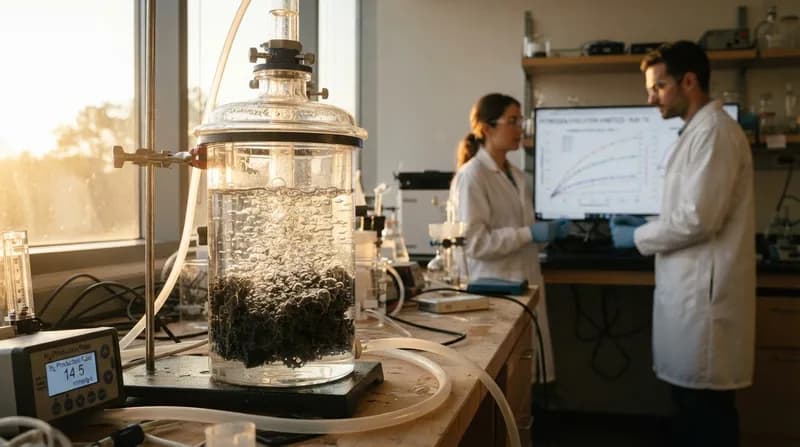
A Paradigm Shift in Solar Fuel Production
For decades, the promise of "green" hydrogen—fuel produced by splitting water molecules using renewable energy—has been hindered by economic realities. The most common industrial methods currently rely on methane-steam reforming, a process that emits carbon dioxide, while existing water-splitting techniques often demand expensive precious metal catalysts to remain efficient. Now, a breakthrough from the Materials Discovery Laboratory (MaD Lab) at Oregon State University is poised to disrupt this status quo.
Led by Kyriakos Stylianou, the research team has successfully developed a new class of photocatalysts based on Metal-Organic Frameworks (MOFs). Unlike traditional systems that depend on costly noble metals, this new material, dubbed BVR-19, leverages sulfur-based chemistry to capture solar energy and drive the chemical reaction necessary to liberate hydrogen from water. This innovative approach effectively shifts the heavy lifting from expensive metal atoms to the framework's organic components.
The Secret Behind BVR-19: Sulfur-Driven Photochemistry
The core innovation of the BVR-19 material lies in its unique molecular architecture. MOFs are porous, crystalline structures composed of metal ions linked by organic molecules, allowing scientists to tune their properties with extreme precision. In the case of BVR-19, the researchers incorporated an unusual sulfide-to-sulfide bond within the organic linkers. When hit by light, these bonds temporarily break to produce highly reactive sulfur species that facilitate the rapid movement of electrons required to produce hydrogen.
This design choice is a significant departure from standard methodologies. By utilizing the organic building blocks to harness light energy, the researchers have eliminated the necessity for an additional, high-cost metal catalyst. Furthermore, the material offers a distinct manufacturing advantage: it forms spontaneously in aqueous solutions at room temperature. This low-energy synthesis process, combined with the material’s inherent stability, establishes a promising path toward scaling production for industrial use.
Why It Matters: Bridging the Cost Gap
The implications for the energy sector are profound. Currently, green hydrogen costs roughly $5 per kilogram, a steep premium compared to the $1.50 per kilogram associated with methane-steam reforming. By providing a new "blueprint" for material design, the OSU team is addressing the two primary obstacles to green hydrogen adoption: infrastructure cost and energy efficiency.
- Sustainable Sourcing: By relying on photocatalysis instead of electrocatalysis, the system avoids the need for external electricity grids, allowing for direct solar-to-fuel conversion.
- Economic Scalability: The elimination of expensive catalysts significantly lowers the barrier to entry for commercializing clean fuel systems.
- Customizable Frameworks: The ability to tweak the metallic components of the MOF while retaining the proven sulfur-based design allows researchers to optimize future iterations for even higher output.
Looking Toward a Hydrogen-Powered Future
The findings, published in the Journal of the American Chemical Society, serve as a foundational step toward more effective solar fuel production. As the global push for decarbonization intensifies—spanning everything from heavy-duty vehicle fuel cells to industrial ammonia and plastics manufacturing—materials like BVR-19 represent a critical technological bridge.
The MaD Lab team intends to use these discovery rules to refine existing MOF structures further. By understanding exactly why specific configurations outperform others, scientists can now iterate on these materials with greater speed and accuracy. This move toward "design-first" chemistry suggests that a future where affordable, sunlight-derived hydrogen plays a central role in the global energy mix is closer than ever before.