The End of Titanium Dioxide and PFAS
For decades, the manufacturing industry has relied on two staples to create white, durable, and water-resistant materials: titanium dioxide (TiO2) pigments and per- and polyfluoroalkyl substances (PFAS). While effective, these chemicals have come under intense scrutiny. Titanium dioxide faces bans as a food additive due to safety concerns, while PFAS—often called 'forever chemicals'—are increasingly recognized for their environmental persistence and health risks. A breakthrough from Kyoto University, published in the journal Nature, offers a radical departure from this chemical-dependent status quo.
The Power of Structural Whiteness
The research team, led by Professor Easan Sivaniah, turned to the natural world to solve this material design dilemma. Nature does not use white pigments to create the brilliance seen in snow, clouds, or the foam of ocean waves. Instead, it utilizes 'structural whiteness.' By creating microscopic, porous architectures that scatter light with extreme efficiency, natural systems produce intense white color through physics rather than chemistry. Inspired by these phenomena and the water-repellent properties of lotus leaves, the researchers engineered a novel material platform that replicates these effects.
Introducing Deep Foam Photolithography (DFP)
The core of this innovation is a technique dubbed Deep Foam Photolithography (DFP). The process begins by exposing a polymer to light, which breaks it down into smaller molecular fragments. Subsequent treatment with a mild solvent induces the polymer to swell, resulting in an open network of microscopic pores. This structural transformation achieves two critical functions simultaneously:
- Optical Brilliance: The porous interior scatters light so effectively that the material appears intensely white without requiring a single drop of pigment.
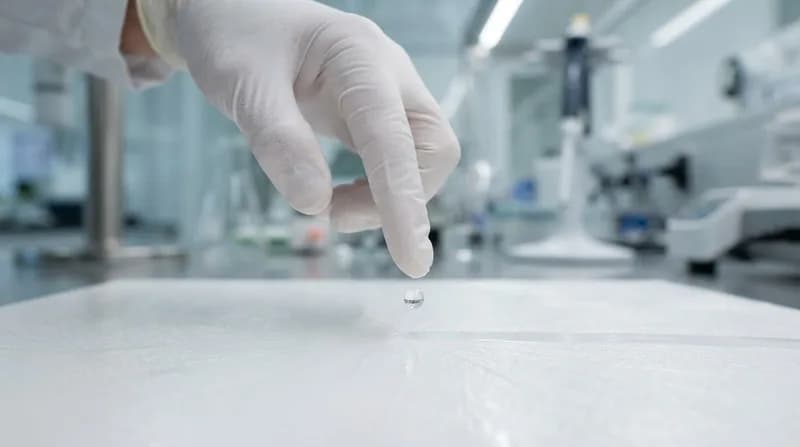
- Surface Hydrophobicity: The resulting rough, foam-like surface architecture naturally repels water, replicating the self-cleaning, hydrophobic properties of a lotus leaf without the need for PFAS coatings.
Implications for Global Manufacturing
The versatility of DFP is one of its most compelling aspects. By collaborating with textile experts at Donghua University, the research team successfully demonstrated the application of this technique beyond simple polymer films to include fabrics and other surfaces. Because the process utilizes existing, commercially available polymers, it avoids the high costs associated with developing entirely new specialty chemicals. Furthermore, the platform can achieve an ultra-high resolution of 20,000 DPI, making it a viable candidate for high-precision manufacturing applications.
This research signals a paradigm shift in material science. By embedding functionality—brightness and water repellency—directly into the physical structure of a material, manufacturers can significantly reduce their reliance on mined mineral pigments and persistent fluorinated coatings. As environmental regulations tighten globally, this biomimetic approach provides a scalable, sustainable pathway forward for packaging, textiles, and consumer products.