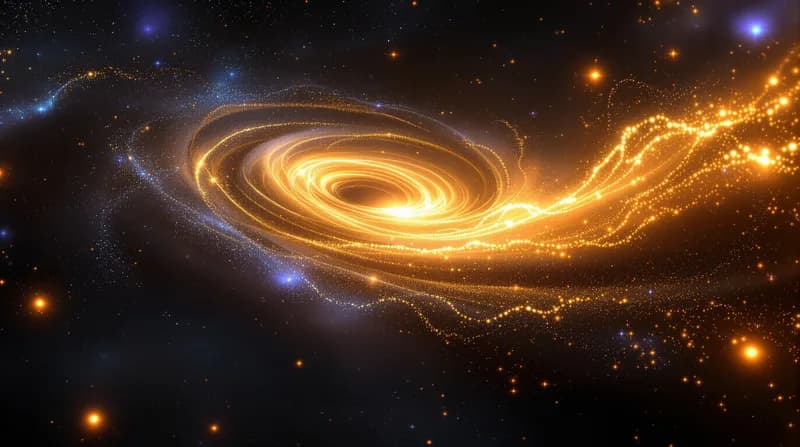
NASA’s James Webb Space Telescope (JWST) has provided astronomers with an unprecedented look at the feeding mechanisms of a supermassive black hole. The observations focus on the center of galaxy NGC 4696, where a vast filament of gas appears to be funneling material into a massive, spinning accretion disk.
A High-Speed Cosmic Buffet
The disk in question spans approximately 800 light-years and consists of gas racing around the black hole at speeds reaching 600 kilometers per second. This level of detail allows researchers to track the flow of matter with higher precision than previously possible, offering new insights into how these gravitational giants sustain themselves.
The Recycling Hypothesis
Perhaps most significantly, the findings suggest a self-sustaining cycle of fuel. Scientists believe that black holes may actually recycle their own fuel by using powerful jets to heat surrounding gas. Once this gas cools down over time, it is drawn back into the black hole’s gravitational pull to be consumed again. This discovery could reshape our understanding of galactic evolution and black hole longevity.