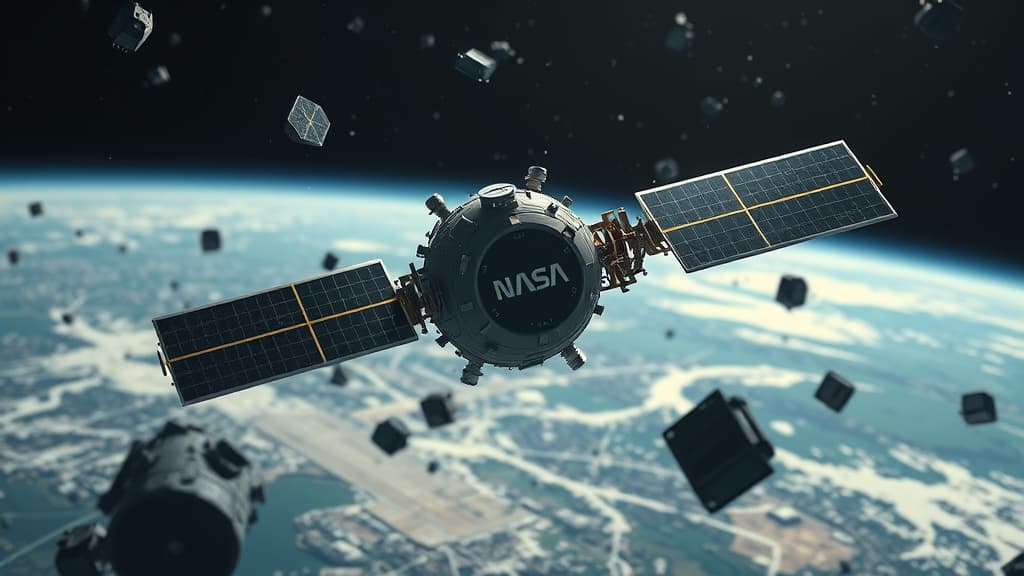
NASA's recent Starling mission has made strides in autonomous space navigation by testing the FALCON system. This innovative technology enables satellites to navigate independently of GPS, utilizing other spacecraft and orbital debris as reference points.
Over a span of three days, the FALCON (Fast Autonomous Lost-in-space Catalog-based Optical Navigation) system autonomously enhanced the orbital estimates of more than 200 space objects. By leveraging a catalog that includes approximately 20,000 known space objects, FALCON has set a new precedent for navigation in deep space exploration.
Key Points
- The FALCON technology allows satellites to determine their orbits autonomously using nearby objects.
- During tests, FALCON improved the orbital estimates of over 200 objects within just three days.
- This initiative is the result of collaboration between NASA and EraDrive, a startup that builds on research from Stanford University.
- FALCON's optical navigation capabilities are essential for deep space missions where GPS signals are unreliable.
- The project exemplifies how university research can evolve into advanced commercial applications in space technology.
This milestone advances NASA's capabilities for future lunar and Martian missions, where traditional navigation methods may be insufficient. The success of FALCON emphasizes the potential of autonomous systems in reducing risk and enhancing operational efficiency in space exploration.