A Tale of Two Hemispheres
For generations, humanity has gazed up at the Moon, observing a stark contrast between its familiar, cratered face and the mysterious, jagged terrain of its far side. While the near side greets us with vast, dark volcanic plains—known as maria—and a relatively thin crust, the far side is a rugged highland landscape, vastly thicker and more heavily cratered. This lunar dichotomy has long stumped astronomers. However, fresh data from China's Chang'e-6 mission, which provided the first-ever samples from the Moon's far side, has finally allowed researchers to peek behind the curtain of this celestial mystery.
The Evidence in the Rocks
A research team led by Professor Hejiu Hui of Nanjing University took an exhaustive approach to this puzzle, analyzing three distinct types of lunar rock: anorthosites, Mg-suite rocks, and mare basalts. By comparing these far-side samples directly with materials returned from previous Apollo and Chang'e-5 missions, the team made a surprising discovery: beneath the crust, the Moon’s mantle composition is remarkably consistent. The chemical signatures of basalts from both hemispheres suggest they originated from similar depleted mantle material. This indicates that while the Moon’s outer appearance is fractured and varied, its interior structure—the foundation left behind as the original magma ocean crystallized—remains largely uniform.
The Mechanism of Asymmetry
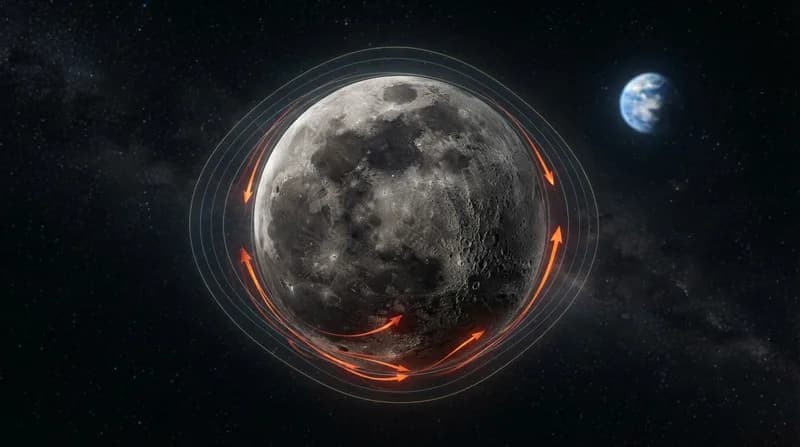
If the mantle is uniform, why is the crust so different? The researchers propose that the answer lies in the intense gravitational relationship between the young Earth and our nascent Moon. According to the team's model, the Moon’s early magma ocean initially cooled in a symmetrical fashion. However, as the Moon became tidally locked, the proximity to Earth created a significant imbalance. The intense gravitational tidal forces exerted on the Moon generated localized heating on the side facing our planet.
This thermal gradient triggered massive, horizontal circulation flows within the molten interior. Essentially, hot magma was pushed from the near side toward the far side, dragging along magnesium-rich material. This process thickened the far side's crust significantly and altered its chemical profile. Meanwhile, the near side became a reservoir for the remaining, late-stage molten elements—specifically those enriched in KREEP (potassium, rare earth elements, and phosphorus) and ilmenite-bearing cumulates. This heat-driven migration effectively separated the crustal materials billions of years ago, creating the geological divide we observe today.
Why It Matters
- Understanding Planetary Formation: This research demonstrates how tidal locking and proximity to a host planet can fundamentally alter the geologic evolution of a satellite.
- Verification of Samples: The mission highlights the critical importance of collecting physical samples, as the Chang'e-6 data provided the final missing piece for a theory that had been debated for decades.
- Thermal Modeling: It confirms that the Moon's early thermal history was far more dynamic than previously thought, involving large-scale mantle circulation driven by external gravitational forces.
Ultimately, these findings shift our perspective of the Moon from a static, unchanging rock to a dynamic body that was actively sculpted by its proximity to Earth. By linking the microscopic analysis of lunar rocks to global-scale tectonic history, scientists have successfully mapped out the life story of Earth's closest celestial neighbor, proving that our fates have been intertwined since the very beginning of the solar system.