A New Chapter in Triassic Evolution
The discovery of a newly identified dinosaur in Zimbabwe, dating back 210 million years, is fundamentally changing our understanding of prehistoric Africa. While the continent is world-renowned for its hominid fossils, this recent find, named Musango matusadonaensis, proves that the fossil-rich grounds of Zimbabwe hold secrets that challenge long-held assumptions about the distribution of early dinosaur species. Paleontologists had historically assumed that Zimbabwean dinosaur finds were simply extensions of the well-documented faunas found in neighboring South Africa. However, this latest evidence suggests the reality was far more complex, pointing toward an isolated and distinct ecosystem driven by ancient climatic variations.
Musango matusadonaensis belongs to the sauropodomorph subgroup—the ancestors of the iconic, long-necked giants like Diplodocus. Anatomical analysis indicates that the specimen was a subadult, measuring approximately 4.5 meters in length and weighing roughly 220 kilograms. Though researchers were unable to recover the skull, they know from the creature's evolutionary lineage that it was likely a herbivore. Perhaps most importantly, it was bipedal, navigating its environment on its hind legs, providing a fascinating snapshot of how these early dinosaurs transitioned toward the massive, quadrupedal forms that would eventually dominate the landscape.
The Expedition: Navigating Matusadona
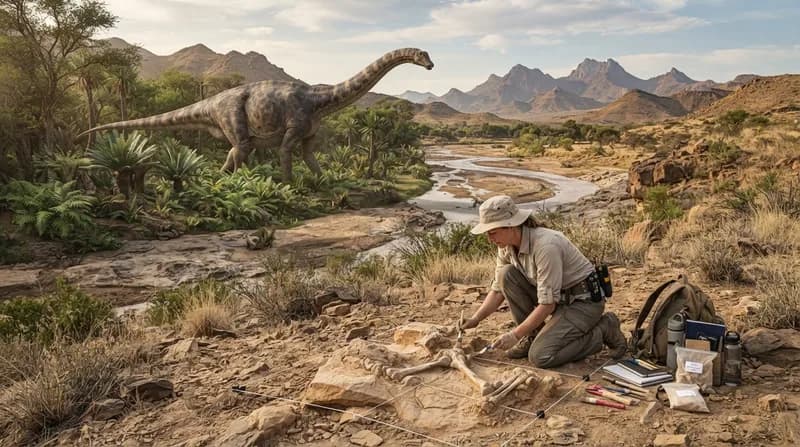
The journey to this discovery was as rigorous as it was ingenious. Following initial reports of productive fossil sites along the shores of Lake Kariba—an artificial lake forming part of the border between Zimbabwe and Zambia—an international team was assembled to conduct a deep-field survey. Because the fossil-bearing mudstones and sandstones were located deep within the Matusadona National Park, the team utilized a houseboat as a mobile laboratory and living space. This allowed for sustained, multi-year expeditions that spanned from 2017 to 2018.
The excavation revealed not just Musango, but a wealth of other prehistoric life, including lungfish and aquatic reptiles known as phytosaurs. These finds are particularly significant because they are either entirely absent or extremely rare in South African fossil records. The geological data indicates that 210 million years ago, the Kariba region was a dry environment characterized by sprawling conifer forests and lush, green corridors of vegetation that hugged ancient watercourses.
Why It Matters
- Climatic Isolation: The findings suggest that northern, equatorial Africa may have hosted entirely different biological communities compared to southern regions due to shifting climate zones.
- Redefining Distribution: Historical assumptions that Zimbabwean fossils were merely proxies for South African species are being systematically dismantled.
- Scientific Methodology: The successful use of a mobile aquatic research platform highlights the potential for future, remote fossil prospecting in difficult-to-reach terrain.
Implications for the Future
As researchers continue to re-examine existing collections in Bulawayo and prepare for return trips to Lake Kariba, the narrative of African dinosaur evolution is becoming increasingly nuanced. The team is now focused on comparing the exact environmental conditions of these sites with others across the globe. By mapping out exactly where and how these species lived, scientists hope to pinpoint the exact environmental pressures that forced such rapid and distinct diversification. This ongoing work not only positions Zimbabwe as a critical hub for global paleontological research but also reinforces that the history of life on Earth is far more regionally diverse than we previously dared to imagine.