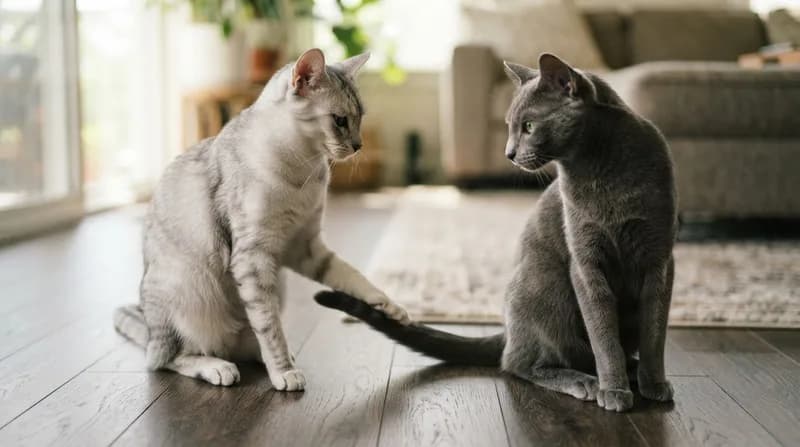
The Discovery of Marfan Syndrome in Felines
In a milestone for veterinary medicine and genetics, researchers at Cornell University have confirmed the first known cases of Marfan syndrome in domestic cats. The discovery centers on two feline siblings, Shaggy and Gary, who captured the attention of experts due to their strikingly long limbs. As the cats matured, further clinical evaluations revealed a constellation of symptoms consistent with the connective tissue disorder, including an enlarged aorta and abnormalities in eye structure.
Marfan syndrome is a complex inherited condition that significantly affects the body's connective tissues—the biological 'glue' that supports blood vessels, bones, and vital organs. While this disorder is relatively well-documented in human medicine, occurring in roughly 1 out of every 4,000 people, it had never before been molecularly confirmed in the feline population. The study, published in Scientific Reports, marks a critical pivot point in understanding how this condition manifests across species.
The Genetic Mechanism Behind the Mutation
To pinpoint the biological driver of the cats' symptoms, the Cornell research team conducted an extensive analysis of the brothers' DNA. The investigation focused on the FBN1 gene, which provides the instructions for producing fibrillin-1, a protein essential for the structural integrity of tissues. In the case of Shaggy and Gary, the researchers discovered that both cats carried two altered copies of this gene—one inherited from each parent. This finding was particularly puzzling because, in humans, possessing even a single mutated copy of FBN1 is typically sufficient to trigger the syndrome.
However, the researchers uncovered a fascinating genetic 'twist.' Unlike standard mutations that completely render a gene non-functional, the variation identified in these cats was hypomorphic. While it significantly interfered with how the gene's instructions were processed, it did not completely silence the protein's production. This residual function allowed the brothers to survive into adulthood, defying the expectations typically associated with homozygous mutations. This delicate balance of partial function explains why the cats exhibited the physical markers of the syndrome without the condition being immediately lethal.
Why it Matters
- Advancing Veterinary Diagnostics: By documenting the molecular characteristics of Marfan syndrome in cats, veterinarians now have a clearer framework for recognizing and diagnosing similar structural anomalies in domestic animals.
- Genetic Testing Development: This research provides the foundation for creating targeted genetic screening tools, enabling breeders and owners to identify carriers of the FBN1 mutation early in a cat's life.
- Comparative Medicine: Studying how the FBN1 gene functions in felines offers a unique perspective on the variability of connective tissue disorders, potentially shedding new light on how similar genetic variations impact protein production in both humans and other mammals.
Ultimately, this case serves as a profound reminder of the complexities of genetic inheritance. Dr. Jacquelyn Evans and the team at the Baker Institute for Animal Health believe that these feline subjects will become instrumental in future studies. By understanding the protective mechanisms that allowed Shaggy and Gary to survive, scientists may gain new insights into the potential for managing similar connective tissue mutations in other living beings, bridging the gap between human and animal pathology in ways previously unimagined.